
O 1A Criteria: Complete Guide to Meeting Requirements

The O-1A visa represents one of the most prestigious nonimmigrant pathways for professionals demonstrating extraordinary ability in their fields. Understanding the o 1a criteria is essential for anyone pursuing this visa category, as meeting these specific requirements determines application success. The O-1 visa program establishes rigorous standards that separate truly exceptional individuals from highly skilled professionals, requiring applicants to provide compelling evidence of sustained national or international acclaim.
Understanding the O-1A Visa Framework
The O-1A visa category specifically addresses individuals with extraordinary ability in sciences, education, business, or athletics. This classification differs from the O-1B category, which covers arts, motion pictures, and television industries. The distinction matters because each category applies different evidentiary standards.
Extraordinary ability under the o 1a criteria means a level of expertise indicating that the person is one of the small percentage who have risen to the very top of their field. This standard exceeds mere competence or even excellence. It requires demonstration of sustained national or international acclaim and recognition.
The Eight-Prong Test Explained
The o 1a criteria establish eight possible categories of evidence that applicants can present. Meeting the threshold requires satisfying at least three of these eight criteria, though quality matters more than quantity. Immigration officers evaluate the totality of evidence to determine whether it demonstrates extraordinary ability.
Here are the eight distinct criteria:
- Major nationally or internationally recognized awards or prizes for excellence in the field of endeavor
- Membership in associations requiring outstanding achievements as judged by recognized experts
- Published material about the beneficiary in professional or major trade publications or major media
- Participation as a judge of the work of others in the same or allied field
- Original contributions of major significance to the field
- Scholarly articles authored by the beneficiary in professional journals or major media
- Employment in a critical or essential capacity for organizations with distinguished reputations
- High salary or remuneration compared to others in the field

Analyzing Award Requirements
The first of the o 1a criteria focuses on major awards and prizes. Not every recognition qualifies under this standard. The award must be nationally or internationally recognized within the field and represent excellence rather than participation.
Nobel Prizes, Pulitzer Prizes, Olympic medals, and similar honors clearly satisfy this criterion. However, most applicants haven't received such prestigious recognition. Immigration authorities recognize that extraordinary ability can be demonstrated through multiple lesser awards or through other criteria.
When evaluating awards, officers consider several factors:
- The reputation and selectivity of the awarding organization
- The geographic scope of the award's recognition
- The number of recipients relative to the field's size
- The criteria used to determine recipients
- Media coverage or industry recognition of the award
Industry-specific awards often carry significant weight. A physician receiving the American Medical Association's top research award or a technology entrepreneur winning TechCrunch Disrupt demonstrates field-specific excellence that satisfies the o 1a criteria.
Membership Evidence Standards
Professional memberships represent another pathway within the o 1a criteria, but standard professional associations don't qualify. The membership must require outstanding achievements as judged by recognized national or international experts in the discipline.
| Qualifying Memberships | Non-Qualifying Memberships |
|---|---|
| Election to National Academy of Sciences | Annual fee-based professional societies |
| Fellowship in specialized medical colleges | University alumni associations |
| Invitation-only expert councils | Open-enrollment trade groups |
| Peer-selected industry fellowships | Continuing education organizations |
The distinction centers on selectivity and expert judgment. If anyone can join by paying dues or meeting basic educational requirements, the membership doesn't demonstrate extraordinary ability. The o 1a criteria demand evidence that peers recognized the applicant's exceptional achievements through a competitive selection process.
Documentation Requirements for Memberships
Strong membership evidence includes the association's bylaws showing selection criteria, statistics on acceptance rates, and letters from the organization explaining the applicant's selection basis. Simply providing a membership card or certificate proves insufficient under current adjudication standards.
Media Coverage and Published Material
The third criterion within the o 1a criteria addresses published material about the beneficiary in professional publications, major trade publications, or major media outlets. This evidence demonstrates that the applicant's work has garnered significant attention within or beyond their field.
Quality trumps quantity in media evidence. A feature article in The New York Times, The Wall Street Journal, or field-specific publications like Nature or Harvard Business Review carries substantial weight. Brief mentions, advertisements, or self-published content don't satisfy this standard.
Immigration officers evaluate published material by examining:
- The publication's circulation and reputation
- Whether the content focuses primarily on the beneficiary
- The context and tone of the coverage
- Whether the material discusses the beneficiary's achievements specifically
For entrepreneurs and business professionals, coverage in Forbes, Bloomberg, TechCrunch, or industry-leading publications demonstrates the recognition expected under the o 1a criteria. Scientists benefit from features in Scientific American, MIT Technology Review, or discipline-specific journals.

Judging and Peer Review Activities
Serving as a judge of others' work represents a powerful indicator of extraordinary ability under the o 1a criteria. This criterion recognizes that exceptional individuals are called upon to evaluate their peers' contributions, whether through grant review panels, journal peer review, competition judging, or similar activities.
Types of Qualifying Judging Activities
Academic peer review constitutes the most common form of judging evidence. Scientists and researchers who review manuscripts for prestigious journals or evaluate grant applications for the National Science Foundation or National Institutes of Health demonstrate recognized expertise.
Beyond academia, the o 1a criteria recognize various judging roles:
- Serving on panels for industry awards or competitions
- Evaluating startups for venture capital firms or accelerators
- Acting as an expert witness in legal proceedings
- Reviewing work for government agencies or international organizations
- Participating in patent examination or technical review boards
Documentation should establish the selective nature of the judging opportunity. Not everyone in the field receives invitations to review for Science or serve on prestigious award panels. Letters from requesting organizations explaining why they selected the beneficiary strengthen this evidence.
Original Contributions of Major Significance
The fifth criterion represents perhaps the most flexible yet challenging aspect of the o 1a criteria. Original contributions of major significance to the field encompass innovations, methodologies, products, or discoveries that advanced the discipline substantially.
Defining "major significance" requires demonstrating that the contribution influenced how others work in the field. Citations of published research, adoption of methodologies, commercial success of inventions, or widespread implementation of innovations all evidence significance.
For researchers, citation metrics provide quantifiable evidence. While no specific citation threshold exists, researchers with hundreds or thousands of citations demonstrate that their work influenced subsequent research. The detailed O-1A visa criteria breakdown emphasizes examining the broader impact of contributions.
Business professionals demonstrate original contributions through:
- Patents with commercial applications or licensing agreements
- Proprietary methodologies adopted across the industry
- Products or services that disrupted markets
- Business models replicated by competitors
- Technology platforms with significant user bases
Expert letters play a crucial role in establishing major significance. Independent experts who can attest to how the beneficiary's contributions changed industry practices or advanced knowledge provide compelling evidence under the o 1a criteria.
Scholarly Publications and Authorship
Authoring scholarly articles in professional journals or major media represents another pathway within the o 1a criteria. This criterion overlaps somewhat with original contributions but focuses specifically on dissemination of knowledge through publication.
| Publication Type | Evidentiary Strength | Considerations |
|---|---|---|
| Peer-reviewed journal articles | High | Journal impact factor matters |
| Conference proceedings | Moderate | Selectivity of conference important |
| Book chapters | Moderate to High | Publisher reputation significant |
| Op-eds in major media | Moderate | Outlet's reach and reputation count |
| Trade publications | Moderate | Industry recognition of publication |
The o 1a criteria don't specify a minimum number of publications. However, applicants typically present multiple scholarly works demonstrating sustained contributions to their field. A single publication rarely satisfies this criterion unless it appeared in an exceptionally prestigious venue and garnered extraordinary recognition.
Impact factors, citation counts, and journal prestige all contribute to the weight given to scholarly publications. Publishing in Cell, Nature, or The Lancet demonstrates achievement that meets the extraordinary ability standard more readily than publishing in newer or regional journals.
Critical or Essential Employment
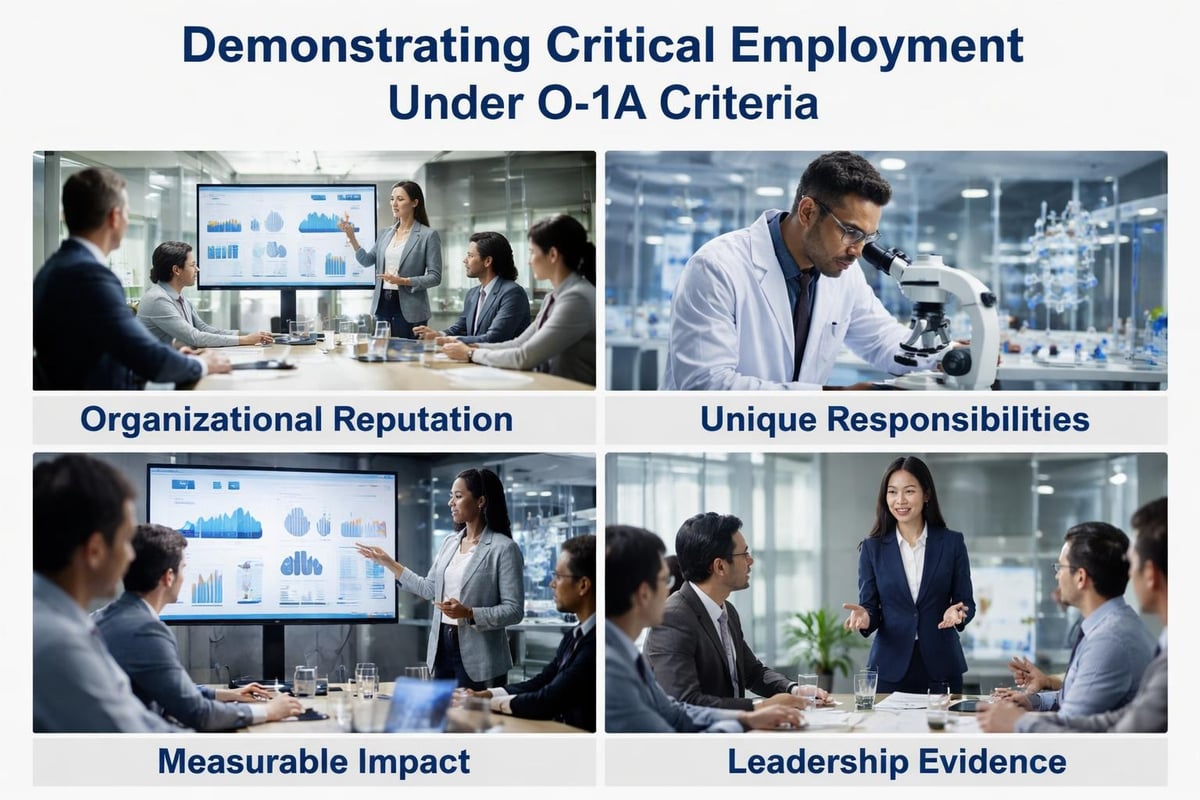
The seventh criterion within the o 1a criteria recognizes that exceptional individuals often hold critical or essential roles for organizations with distinguished reputations. This pathway particularly benefits business professionals and executives whose extraordinary ability manifests through organizational leadership rather than awards or publications.
Employment evidence must demonstrate two elements: the organization's distinguished reputation and the beneficiary's critical or essential role. Fortune 500 companies, leading universities, renowned research institutions, and prestigious nonprofits generally satisfy the organizational reputation requirement.
Documenting Critical Role
Proving a critical or essential role requires more than a senior job title. The o 1a criteria demand evidence that the organization depends significantly on the beneficiary's contributions. Strong documentation includes:
- Organizational charts showing reporting structure and span of control
- Letters from executives explaining the beneficiary's unique responsibilities
- Evidence of projects or initiatives led by the beneficiary
- Revenue, funding, or operational metrics tied to the beneficiary's work
- Media coverage highlighting the beneficiary's role in organizational success
Entrepreneurs leading successful startups can leverage this criterion by demonstrating their company's distinguished reputation through funding secured, revenue generated, customer base, industry recognition, or strategic partnerships established.
High Salary and Compensation
The eighth and final criterion addresses high salary or remuneration for services compared to others in the field. This provides a market-based validation of extraordinary ability, operating on the principle that exceptional talent commands exceptional compensation.
Establishing comparative salary data presents the primary challenge with this criterion. Immigration officers need evidence showing that the beneficiary's compensation significantly exceeds the norm for their field, position, and geographic location. The USCIS entrepreneur pathways guidance acknowledges compensation as one indicator of extraordinary ability.
Sources for comparative salary evidence include:
- Bureau of Labor Statistics occupational wage data
- Industry-specific salary surveys from professional associations
- Compensation reports from specialized recruiting firms
- Expert letters from human resources professionals
- Academic studies on compensation in the field
Geographic considerations matter significantly. A salary of $200,000 might place someone in the top tier in some regions or industries but represent only average compensation in others. The o 1a criteria require compensation that's high relative to the specific field and location.
Strategic Approach to Meeting O 1A Criteria
Most successful applications present evidence across four to six of the eight o 1a criteria rather than barely meeting the three-criterion minimum. This strategy demonstrates extraordinary ability through multiple dimensions and provides redundancy if immigration officers question certain evidence.
Quality consistently outweighs quantity when presenting evidence. Twenty minor industry awards carry less weight than three nationally recognized prizes. Hundreds of blog mentions don't substitute for a feature article in a major publication. The detailed guidance on O-1A visas emphasizes focusing on the most compelling evidence.
Building a Compelling Narrative
Beyond meeting individual criteria, successful petitions tell a coherent story about the beneficiary's extraordinary ability. The evidence should demonstrate a pattern of sustained achievement and recognition over time rather than isolated accomplishments.
Expert letters integrate evidence across multiple criteria, explaining how various achievements collectively demonstrate extraordinary ability. Independent experts who can contextualize the beneficiary's contributions within the field provide credibility that raw documentation alone cannot achieve.
The strongest expert letters:
- Come from recognized authorities in the field
- Demonstrate the expert's own qualifications and knowledge
- Specifically address multiple o 1a criteria
- Explain why the beneficiary's achievements are extraordinary
- Compare the beneficiary favorably to peers in the field
Common Challenges and Solutions
Applicants frequently encounter specific challenges when compiling evidence for the o 1a criteria. Understanding these obstacles allows for proactive strategy development.
Early-career professionals often struggle to demonstrate sustained acclaim. However, exceptional early achievements can satisfy the o 1a criteria. A doctoral candidate with breakthrough research, significant publications, and major grants demonstrates extraordinary ability despite limited career duration.
Entrepreneurs face unique challenges since traditional academic or corporate evidence may not apply. They should emphasize funding secured, company valuation, market disruption, media coverage, and industry awards. Revenue growth, customer adoption, and strategic partnerships provide concrete evidence of impact.
Professionals in emerging fields may lack established award structures or prestigious publications. These applicants should focus on being pioneers, documenting how their work defined the field, influenced others, or created new paradigms. Expert letters become particularly important in explaining the significance of achievements in nascent disciplines.
| Challenge | Strategic Solutions |
|---|---|
| Limited publications | Emphasize patents, proprietary methods, or media coverage |
| Few awards in field | Focus on memberships, judging roles, and original contributions |
| Early career stage | Highlight rapid progression, unique opportunities, expert recognition |
| Non-traditional background | Document cross-disciplinary impact and field-changing innovations |
Preparing Strong Documentation
Each piece of evidence supporting the o 1a criteria requires proper documentation. Immigration officers cannot verify claims without adequate supporting materials, and incomplete documentation leads to delays or denials.
Award evidence should include the award certificate or notification along with materials describing the award's prestige, selection criteria, and previous recipients. If the award isn't widely known, supplementary materials establishing its significance become essential.
For membership criteria, provide the organization's bylaws or admission requirements, evidence of the selection process, and letters explaining the membership's exclusivity. Statistics showing acceptance rates or membership numbers relative to the field's size strengthen this evidence.
Published material about the beneficiary requires copies of the actual publications along with circulation data, publication descriptions, and context about the outlet's reputation. Screenshots of online articles should include metadata showing publication date and outlet.
Translation and Certification Requirements
All foreign-language documents must include certified English translations. The translator must certify that they are competent to translate and that the translation is accurate and complete. This requirement applies to award certificates, publications, letters, and any other evidence submitted.
Authentication of documents from certain countries may require additional certification or apostille. While immigration petitions don't always demand notarization, having key documents properly certified prevents delays from requests for evidence.
Timeline and Strategic Considerations
Understanding the o 1a criteria represents only one aspect of successful petition strategy. Timing considerations affect evidence gathering and application submission.
Most applicants require three to six months to compile comprehensive evidence meeting the o 1a criteria. This timeline allows for obtaining expert letters, gathering documentation, securing translations, and properly organizing materials. Rushing the process often results in incomplete evidence or missed opportunities to strengthen the petition.
Premium processing provides 15-day adjudication for an additional fee, though this expedited timeline applies only after submission. The preparation phase cannot be rushed without sacrificing quality.
Recent approval trends from the comprehensive O-1A visa guide indicate that well-prepared petitions meeting clearly articulated o 1a criteria standards receive favorable decisions at high rates. However, petitions that barely meet the minimum three-criterion threshold face heightened scrutiny.
Evidence Evaluation and Totality Standard
Immigration officers evaluate o 1a criteria evidence through a two-step process. First, they determine whether the applicant meets at least three of the eight criteria. Second, they perform a final merits determination examining the totality of evidence to confirm extraordinary ability.
Meeting three criteria doesn't guarantee approval. The second-step totality analysis considers whether the evidence, taken collectively, demonstrates the level of expertise indicating the beneficiary is one of a small percentage who have risen to the very top of the field.
This totality standard means that:
- Quality of evidence matters more than quantity
- Context and explanation enhance raw documentation
- Expert perspectives help officers understand significance
- Coherent narrative strengthens individual pieces of evidence
- Comparison to field norms provides essential context
Recent policy memos emphasize that officers should consider the totality of evidence without requiring every piece to individually prove extraordinary ability. However, this also means weak evidence in some categories must be offset by particularly strong evidence in others.
Field-Specific Considerations
Different fields present unique opportunities and challenges under the o 1a criteria. Understanding these field-specific dynamics allows for more strategic evidence compilation.
Sciences and Research
Scientists typically build petitions around publications, citations, grants, peer review activities, and original contributions. The research community's established metrics (impact factors, citation counts, grant funding levels) provide quantifiable evidence that translates well under the o 1a criteria.
Collaboration presents both opportunities and challenges in research settings. Highly cited papers with multiple authors require careful explanation of the beneficiary's specific contributions. Letters from co-authors or principal investigators clarifying roles strengthen collaborative evidence.
Business and Entrepreneurship
Business professionals often rely on critical employment, high salary, and original contributions criteria. Entrepreneurs may emphasize funding secured, company valuation, market disruption, or proprietary innovations.
Quantifiable business metrics strengthen entrepreneurial petitions. Revenue growth, customer acquisition, market share, or user engagement numbers provide concrete evidence of impact that satisfies the o 1a criteria when properly contextualized.
The O-1 visa resource from specialized immigration firms notes that business professionals benefit from documenting media coverage, speaking engagements, and industry recognition that might not appear in traditional academic evidence.
Technology and Innovation
Technology professionals blend elements from multiple fields. Software engineers might present patents, published code repositories with significant adoption, technical publications, or critical roles at leading technology companies.
Open-source contributions can demonstrate original contributions when they show widespread adoption and impact. GitHub stars, downloads, or incorporation into major projects provide metrics comparable to citation counts in academic fields.
Successfully navigating the o 1a criteria requires strategic planning, comprehensive documentation, and clear presentation of extraordinary ability across multiple dimensions. The eight-criterion framework provides flexibility, allowing professionals from diverse fields to demonstrate their exceptional achievements through the most relevant evidence for their discipline. If you're ready to pursue an O-1A visa and need expert guidance through the complex documentation and application process, O1 Experts can help you assess your eligibility, compile compelling evidence, and submit a strong petition that effectively demonstrates your extraordinary ability.
Ready To Get Started?
Fill out the form and our expert team will get back to you shortly.
Office Hours
Monday - Sunday: 8AM - 8PM PST
Our Address
609 Metairie Rd
#4013
Metairie, LA 70005