
EB-1A Green Card: Complete Guide for 2026 Applicants

The EB-1A green card represents one of the most prestigious pathways to permanent residence in the United States, designed specifically for individuals who have demonstrated extraordinary ability in their field. Unlike other employment-based green cards, the EB-1A category allows self-petitioning without employer sponsorship, making it an attractive option for accomplished professionals seeking immigration flexibility. Understanding the nuances of this visa category can make the difference between approval and denial, particularly as immigration policies continue to evolve in 2026.
Understanding the EB-1A Green Card Category
The employment-based first preference EB-1A category focuses on foreign nationals who have risen to the top of their profession in sciences, arts, education, business, or athletics. This classification does not require a specific job offer or labor certification, distinguishing it from most other green card pathways.
Key advantages of the EB-1A include:
- No employer sponsorship required
- No labor certification process
- Priority processing in the employment-based preference system
- Ability to self-petition
- Eligibility for premium processing in some circumstances
The eb 1a green card pathway stands apart because it recognizes individual achievement rather than employer need. This fundamental difference creates opportunities for entrepreneurs, researchers, artists, and business leaders who want permanent residence without traditional employment constraints.

Eligibility Requirements and Evidence Standards
Meeting the eligibility threshold for an eb 1a green card requires demonstrating extraordinary ability through extensive documentation. Applicants must satisfy either the one-time achievement criterion or meet at least three out of ten regulatory criteria established by USCIS.
One-Time Achievement Standard
The most straightforward path involves demonstrating receipt of a major internationally recognized award. Examples include:
- Nobel Prize
- Academy Award (Oscar)
- Olympic Medal
- Pulitzer Prize
- Grammy Award (in applicable categories)
Few applicants qualify through this route, making the alternative three-out-of-ten criteria pathway more common for most eb 1a green card petitioners.
The Ten Regulatory Criteria
Applicants who haven't received a major award must provide evidence meeting at least three of these criteria:
| Criterion | Evidence Type | Examples |
|---|---|---|
| Awards/Prizes | Recognition for excellence | Industry awards, national honors, scholarships |
| Membership | Exclusive associations | Professional organizations requiring outstanding achievement |
| Published Material | Press coverage about you | Newspaper articles, trade publications, media features |
| Judging | Evaluation of others' work | Grant reviewer, competition judge, peer reviewer |
| Original Contributions | Significant impact in field | Patents, research breakthroughs, innovative methodologies |
| Scholarly Articles | Authored publications | Peer-reviewed journals, books, significant trade publications |
| Exhibitions/Showcases | Display of work | Gallery exhibitions, museum displays, theatrical productions |
| Leading Role | Principal position | Department head, executive role in distinguished organization |
| High Salary | Top compensation | Salary evidence showing top percentile in field |
| Commercial Success | Financial achievements | Box office receipts, sales records, revenue generation |
The USCIS Policy Manual provides detailed guidance on how adjudicators evaluate evidence under each criterion, making it essential reading for serious applicants.
Building a Compelling EB-1A Petition
Success with an eb 1a green card petition requires more than simply meeting minimum criteria. The evidence must collectively demonstrate sustained national or international acclaim and recognition as one of the small percentage who have risen to the very top of the field.
Documentation Strategy
Strategic evidence compilation separates approved petitions from denials. Each piece of documentation should connect to a broader narrative of extraordinary achievement.
Essential documentation components include:
- Comprehensive professional resume highlighting achievements
- Expert letters from recognized authorities in your field
- Published articles, citations, and impact metrics
- Awards, honors, and recognition certificates
- Evidence of membership in selective professional associations
- Documentation of judging or review activities
- Published material about you in professional or major media
- Proof of original contributions through patents, publications, or innovations
The petition must establish not only that criteria are met, but that the applicant's achievements represent sustained acclaim. A one-time viral social media post differs significantly from sustained media coverage in prestigious outlets over several years.

Expert Recommendation Letters
Recommendation letters serve as crucial evidence in eb 1a green card applications. These letters must come from recognized experts who can credibly evaluate your contributions and standing in the field.
Effective recommendation letters should:
- Come from independent experts, not just colleagues or supervisors
- Demonstrate the recommender's own credentials and authority
- Specifically address your extraordinary achievements
- Compare your work to others in the field
- Include concrete examples of impact and recognition
- Explain how you meet the sustained acclaim standard
Weak letters from unknown sources or those lacking specific details about achievements can undermine otherwise strong petitions. Quality matters more than quantity, though including 5-8 strong letters from diverse sources strengthens most applications.
Common Challenges and How to Address Them
The eb 1a green card process presents specific challenges that trip up many qualified applicants. Understanding these obstacles helps applicants prepare stronger initial petitions.
Proving Sustained Acclaim
USCIS requires evidence of sustained acclaim, not just recent achievements. A single viral moment or one successful project typically won't suffice. Instead, petitions should demonstrate:
- Consistent recognition over multiple years
- Progressive advancement in the field
- Ongoing impact and influence
- Current relevance in 2026
Applicants who peaked years ago without recent accomplishments face scrutiny about whether they maintain extraordinary ability status.
Field Definition Issues
Defining your field too broadly or too narrowly creates problems. An astrophysicist claiming extraordinary ability in "science" sets an impossibly high bar. Conversely, defining the field as "computational modeling of stellar nucleosynthesis in binary systems" may appear overly narrow.
The appropriate field definition should:
- Align with how professional communities organize themselves
- Have recognized experts, publications, and organizations
- Neither be so broad that acclaim is impossible nor so narrow that it lacks legitimacy
- Match the applicant's actual expertise and achievements
Regional vs. National Acclaim
Many accomplished professionals have strong regional reputations but struggle to demonstrate national or international recognition. The eb 1a green card requires acclaim beyond local or regional boundaries.
Strategies to demonstrate broader impact include:
- National media coverage rather than local newspapers
- Speaking engagements at national conferences, not just regional events
- Publications in nationally or internationally distributed outlets
- Professional organization leadership at national level
- Client base or influence spanning multiple states or countries
EB-1A vs. Other Immigration Options
Understanding how the eb 1a green card compares to alternatives helps applicants choose the optimal pathway. For many professionals with extraordinary ability, the O-1 visa serves as either a stepping stone or alternative to the EB-1A green card.
EB-1A vs. O-1 Visa Comparison
| Factor | EB-1A Green Card | O-1 Visa |
|---|---|---|
| Status | Permanent residence | Temporary nonimmigrant |
| Sponsorship | Self-petition possible | Requires U.S. employer/agent |
| Standard | Extraordinary ability | Extraordinary ability |
| Evidence | More stringent | Slightly more flexible |
| Validity | Permanent (conditional on maintaining status) | Up to 3 years initially, renewable |
| Processing Time | 6-12+ months (longer without premium processing) | 2-4 months standard, 15 days with premium |
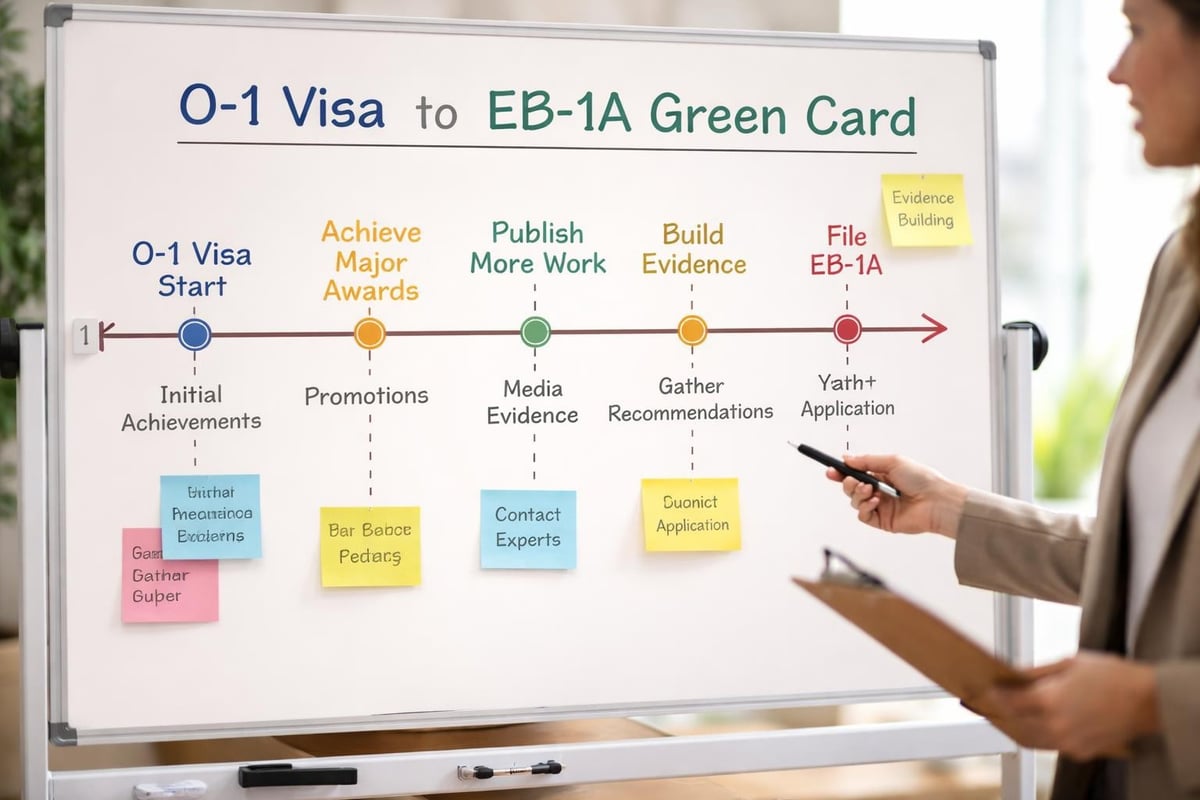
Many applicants pursue O-1 visa options while building stronger evidence for an eventual EB-1A petition. The O-1 visa provides work authorization and U.S. presence while accumulating additional achievements, publications, and recognition.
Application Process and Timeline
Filing an eb 1a green card petition involves multiple steps, each requiring careful attention to detail and proper documentation. The process begins with Form I-140, the Immigrant Petition for Alien Worker.
Step-by-Step Filing Process
1. Evidence Compilation (2-4 months)
Gather all documentation supporting your extraordinary ability claim. This phase often takes longer than expected as applicants collect letters, publications, media coverage, and other supporting materials.
2. Petition Preparation (1-2 months)
Organize evidence into a coherent narrative demonstrating how you meet eligibility criteria. This includes drafting a detailed cover letter explaining your qualifications and how evidence supports each criterion claimed.
3. Form I-140 Filing
Submit the completed I-140 petition with all supporting documentation and filing fees to USCIS. As of 2026, the standard filing fee is $700, with premium processing available for an additional $2,500 in some cases.
4. USCIS Review (6-12 months standard, 15 business days with premium processing)
USCIS adjudicates the petition, potentially issuing a Request for Evidence (RFE) if additional documentation is needed. Premium processing guarantees a response within 15 business days but doesn't guarantee approval.
5. Adjustment of Status or Consular Processing (3-12 months)
Once I-140 is approved, applicants either adjust status if already in the U.S. or process through consular proceedings if abroad. Priority dates and visa bulletin availability may affect timing.
Current Processing Times in 2026
Processing times vary significantly by service center and whether premium processing is utilized. The U.S. Department of State provides visa availability information through monthly visa bulletins, though EB-1 typically has shorter wait times than other employment-based categories.
Standard processing currently ranges from 6-18 months for I-140 petitions, while premium processing provides 15-day decisions. However, overall timeline to green card also includes adjustment of status or consular processing, adding several additional months.
Maximizing Your EB-1A Success Rate
Strategic preparation significantly improves approval odds for eb 1a green card petitions. Professional guidance often makes the difference between approval and denial, particularly for applicants in fields where extraordinary ability standards are less clearly defined.
Building Evidence Over Time
The strongest petitions result from years of strategic career development and documentation. Professionals should:
- Maintain comprehensive records of all achievements and recognition
- Seek speaking opportunities at national conferences and events
- Pursue publication opportunities in respected outlets
- Document citations and impact of published work
- Cultivate relationships with recognized experts who can provide recommendation letters
- Join selective professional organizations requiring demonstrated achievement
- Pursue judging, peer review, or evaluation opportunities in your field
For those currently on O-1 status, the time in the United States provides valuable opportunities to accumulate additional U.S.-based achievements, media coverage, and professional recognition that strengthens a future EB-1A petition.
Working with Immigration Specialists
The complexity of eb 1a green card petitions makes professional assistance valuable for most applicants. Experienced immigration practitioners understand current adjudication trends, evidence standards, and effective petition strategies.
Professional assistance provides:
- Objective evaluation of qualification strength
- Strategic guidance on evidence gathering
- Expertise in petition structuring and presentation
- Knowledge of current USCIS policies and trends
- Response strategies for Requests for Evidence
- Timeline management and process coordination
Organizations like O1 Experts specialize in extraordinary ability immigration matters, bringing deep expertise in both O-1 and EB-1A cases.
Industry-Specific Considerations
Different fields face unique challenges in demonstrating extraordinary ability for eb 1a green card purposes. USCIS applies the same regulatory framework across all fields, but evidence types and standards vary significantly.
Sciences and Research
Scientists must typically demonstrate impact through publications, citations, peer review activities, and original contributions. Key metrics include:
- Publication count in high-impact journals
- Citation metrics (h-index, total citations, field-normalized indicators)
- Grant funding received as principal investigator
- Patents and commercialized innovations
- Editorial board service on respected journals
- Invited presentations at major conferences
The scientific community's emphasis on quantifiable metrics makes objective measurement easier but also creates high thresholds in competitive fields.
Arts and Entertainment
Artists, musicians, actors, and other entertainment professionals demonstrate extraordinary ability through different evidence types. Performance-based fields emphasize:
- Reviews in major publications
- Box office or sales success
- Awards and nominations from recognized organizations
- Leading roles in distinguished productions
- Critical acclaim from respected critics
- Commercial success metrics
Those working in entertainment fields often have strong visual portfolios but may need strategic framing to demonstrate sustained national acclaim rather than regional recognition.
Business and Entrepreneurship
Business professionals face particular challenges proving extraordinary ability without traditional academic publications or industry awards. Strong business petitions typically include:
- Executive leadership roles in distinguished organizations
- Company revenue or growth metrics
- Industry recognition and media coverage
- Speaking engagements at major business conferences
- Published thought leadership in respected business publications
- Demonstrated impact on industry practices or standards
Entrepreneurs must carefully document not just business success but recognition as one of the small percentage at the top of their field.
Request for Evidence Response Strategies
Approximately 30-40% of eb 1a green card petitions receive Requests for Evidence (RFEs) from USCIS. These requests ask for additional documentation or clarification on specific points. Strategic RFE responses often salvage initially insufficient petitions.
Common RFE Issues
USCIS frequently questions:
- Whether evidence demonstrates sustained acclaim versus one-time achievements
- How the applicant's field should be defined
- Whether acclaim is truly national/international rather than regional
- The independence and credibility of recommendation letter authors
- Whether original contributions meet significance standards
- How the applicant plans to continue work in their field of extraordinary ability
Effective RFE responses directly address each concern with additional evidence and detailed explanations. Simply resubmitting the same evidence rarely succeeds.
Building Stronger Initial Petitions
The best RFE response strategy involves avoiding RFEs through comprehensive initial petitions. This requires:
- Anticipating potential USCIS concerns and addressing them proactively
- Providing context for evidence that might not be self-explanatory
- Including detailed cover letters explaining how evidence meets each criterion
- Submitting objective evidence rather than relying solely on subjective claims
- Documenting the significance and selectivity of awards, memberships, and recognition
Professional petition preparers understand common RFE patterns and structure initial submissions to minimize adjudication concerns.
The eb 1a green card pathway offers extraordinary opportunities for accomplished professionals seeking permanent U.S. residence, but success requires strategic planning, comprehensive documentation, and expert guidance. Whether you're currently building your evidence portfolio or ready to file, professional support can significantly improve your approval odds. O1 Experts brings specialized expertise in extraordinary ability immigration matters, helping professionals navigate both O-1 visa and EB-1A green card processes with personalized guidance tailored to your field and achievements.
Ready To Get Started?
Fill out the form and our expert team will get back to you shortly.
Office Hours
Monday - Sunday: 8AM - 8PM PST
Our Address
609 Metairie Rd
#4013
Metairie, LA 70005