
O1 Spouse Visa: Rights, Limitations & Options in 2026
When you receive approval for an O-1 visa based on your extraordinary abilities, one of your first concerns likely involves bringing your spouse to the United States. The o1 spouse visa, technically known as the O-3 dependent visa, allows your husband or wife to accompany you during your stay in America. However, this visa category comes with specific requirements, notable limitations, and considerations that every O-1 visa holder should understand before making plans for their family.
Understanding the O-3 Dependent Visa Status
The O-3 visa serves as the official dependent category for spouses and unmarried children under 21 years of age of O-1 visa holders. This classification falls under the broader framework of nonimmigrant visas designed to keep families together while the principal visa holder works in the United States.
Your spouse qualifies for O-3 status if:
- You hold a valid O-1A visa (for individuals with extraordinary ability in sciences, education, business, or athletics)
- You hold a valid O-1B visa (for those with extraordinary ability in arts or extraordinary achievement in motion picture or television)
- You maintain valid status throughout their requested period of stay
- Your marriage is legally recognized
The O-3 visa category as outlined by USCIS provides a straightforward path for family reunification, but understanding its scope is essential for proper planning.
Duration and Validity Period
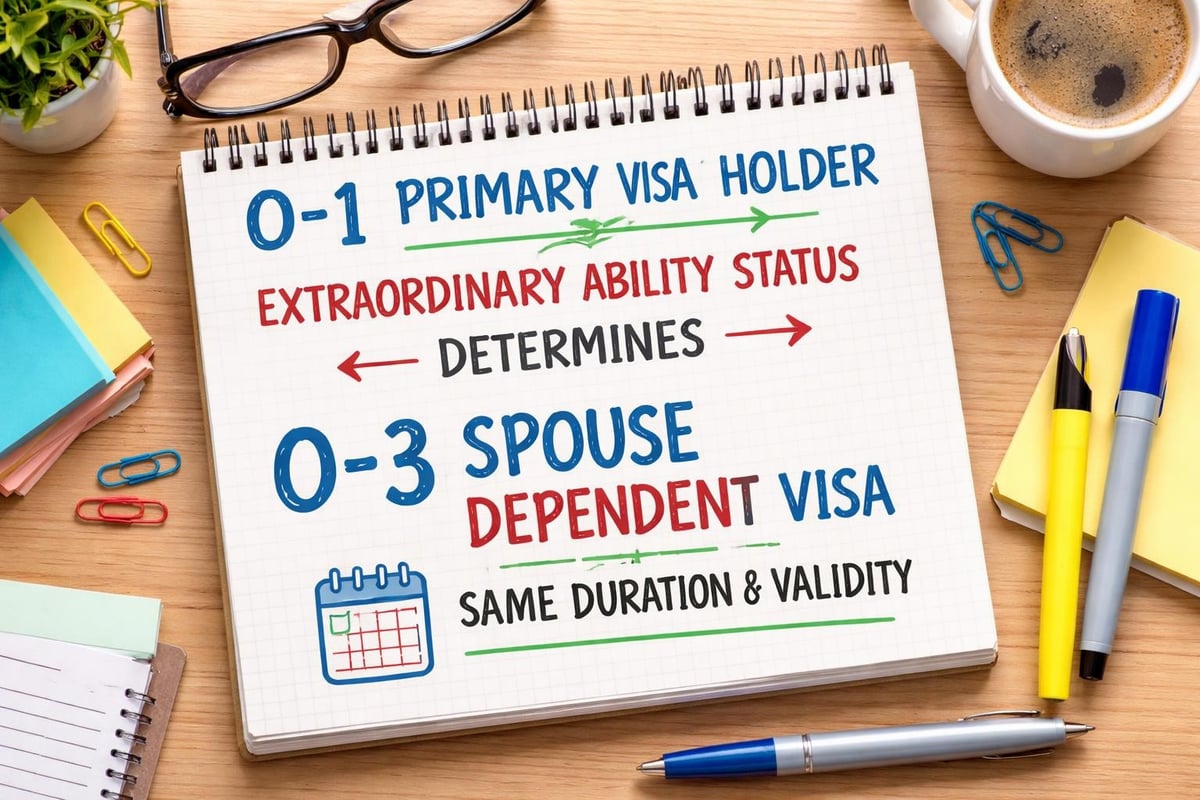
An o1 spouse visa remains valid only as long as the principal O-1 holder maintains their status. The O-3 dependent cannot outlast the O-1 visa period, creating a direct connection between both statuses.
Immigration officials typically grant O-3 visas for the same duration as the principal O-1 visa, though they may issue shorter periods in certain circumstances. If you extend your O-1 status, your spouse must also file for an extension to continue their legal stay in the United States.
Application Process for O1 Spouse Visa
Applying for an o1 spouse visa involves several critical steps that require careful attention to documentation and timing. The process differs slightly depending on whether your spouse applies from outside the United States or seeks to change status while already in America.
Required Documentation
| Document Type | Specific Requirements | Purpose |
|---|---|---|
| Form I-539 | Application to Extend/Change Status (if in U.S.) | Status change or extension |
| Form DS-160 | Online visa application (if abroad) | Consular processing |
| Marriage Certificate | Original or certified copy | Prove legal relationship |
| O-1 Approval Notice | Copy of I-797 | Demonstrate principal's valid status |
| Financial Evidence | Bank statements, employment letter | Show ability to support spouse |
| Passport | Valid for 6 months beyond intended stay | Travel document |
The petitioner for an O-3 visa must demonstrate sufficient financial resources to support their spouse during the stay. This requirement ensures the dependent will not become a public charge.
Filing Steps for O-3 Status
- Gather supporting documents proving your marriage and your valid O-1 status
- Complete Form I-539 if your spouse is already in the U.S. under another status
- Submit the application package with all required evidence and fees to USCIS
- Attend a visa interview at a U.S. consulate if applying from abroad
- Await approval which typically takes 2-4 months for routine processing
According to the USCIS Policy Manual on family members of O-1 holders, spouses may also apply for premium processing in certain situations, reducing wait times to 15 calendar days for an additional fee.
Major Limitations of the O1 Spouse Visa
The most significant restriction affecting O-3 visa holders centers on employment authorization. This limitation represents the primary drawback for many couples considering this immigration pathway.
Employment Restrictions
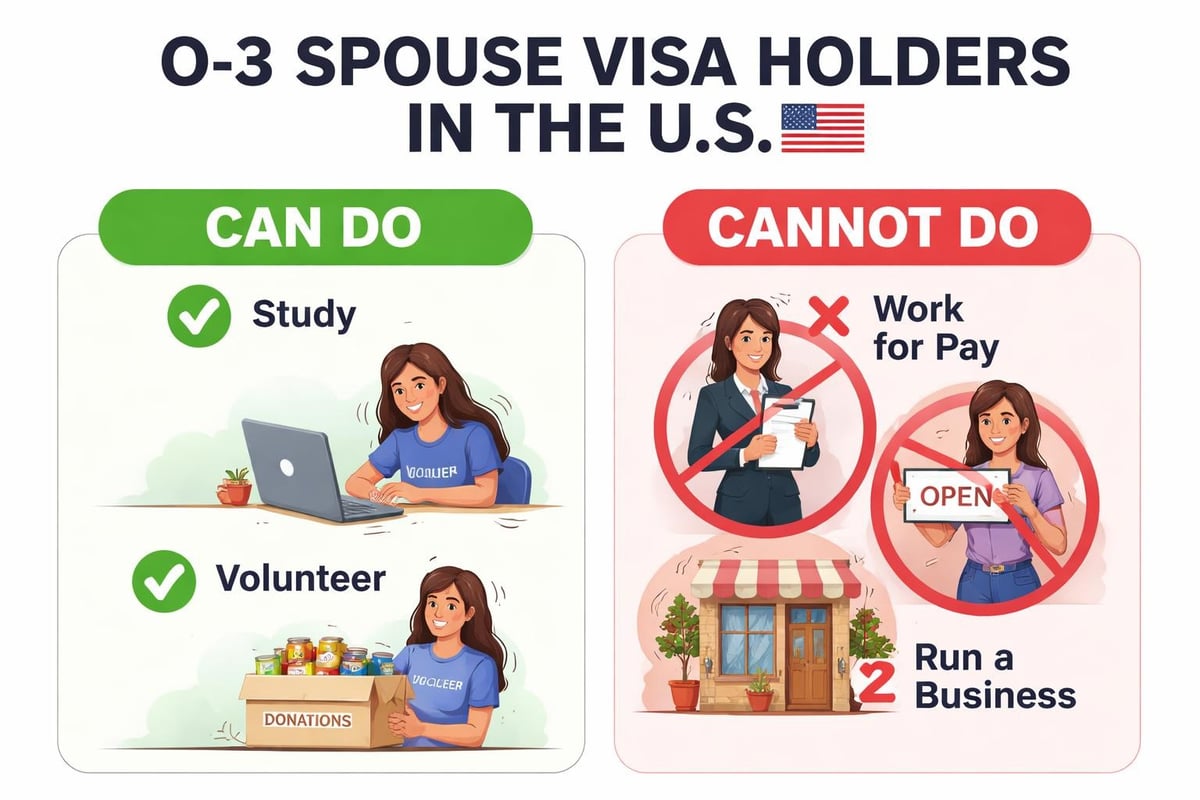
O-3 visa holders cannot:
- Accept paid employment in the United States
- Work as independent contractors or freelancers
- Start their own business operations
- Receive any form of compensation for services rendered
This prohibition applies regardless of your spouse's qualifications, professional background, or career achievements. Many immigration advocates have noted this restriction as a significant burden on families and have recommended policy changes to grant work authorization to O-3 spouses.
The lack of work authorization can create financial strain on families, particularly in expensive metropolitan areas where O-1 holders often work. It may also impact your spouse's career trajectory and professional development during their time in the United States.
Permitted Activities Under O-3 Status
While employment remains off-limits, your spouse can engage in several meaningful activities:
- Full-time or part-time study at any accredited educational institution
- Volunteer work for charitable organizations without compensation
- Personal investments that don't involve active management
- Household management and childcare responsibilities
These permitted activities offer some opportunities for personal growth and community engagement, though they don't address the income limitation.
Alternative Pathways for Spouse Employment
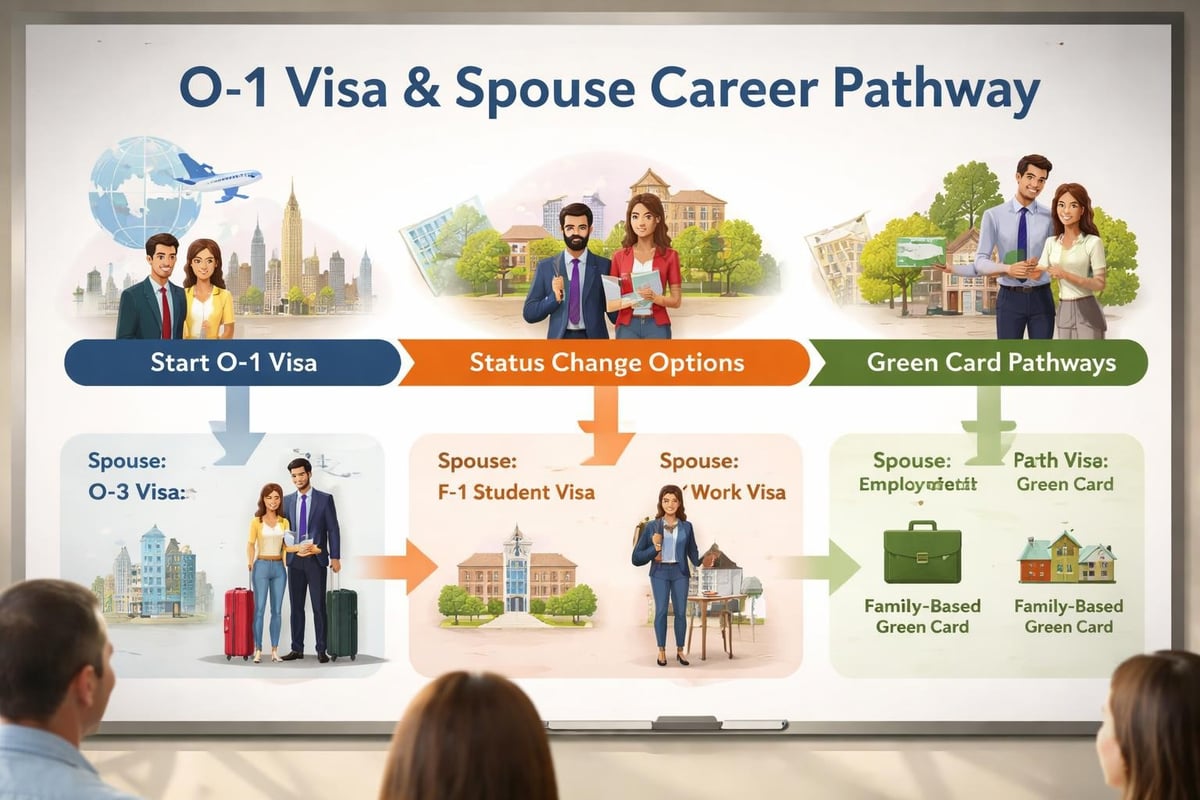
Given the employment restrictions inherent in o1 spouse visa status, many couples explore alternative immigration strategies that would allow the spouse to work legally in the United States.
Changing to F-1 Student Status
One common approach involves the spouse enrolling in a degree program and changing status to F-1. This pathway offers several advantages:
Students on F-1 visas can work on campus up to 20 hours weekly during academic terms and full-time during breaks. After completing one academic year, F-1 students become eligible for Curricular Practical Training (CPT) for work directly related to their field of study.
Additionally, upon graduation, F-1 students can apply for Optional Practical Training (OPT), which grants 12 months of work authorization. STEM degree holders may qualify for a 24-month extension, providing up to 36 months total.
Applying for H-1B or O-1 Status
If your spouse possesses their own extraordinary abilities or specialized skills, they might qualify for their own work visa. The H-1B specialty occupation visa represents one option, though it requires employer sponsorship and is subject to annual caps.
Alternatively, if your spouse has achieved extraordinary ability in their field, they could apply for their own O-1 visa. This approach transforms them from a dependent into a principal visa holder with full work authorization.
| Visa Type | Work Authorization | Duration | Sponsor Required |
|---|---|---|---|
| O-3 | None | Tied to O-1 | No |
| F-1 | Limited (CPT/OPT) | Program length + OPT | Educational institution |
| H-1B | Full | 3 years (renewable) | Employer |
| O-1 | Full | 3 years (renewable) | Employer/Agent |
Pursuing Employment-Based Green Card
For long-term solutions, consider pursuing permanent residency through employment-based immigration. If you qualify for an EB-1A green card (for individuals with extraordinary ability), you can self-petition without employer sponsorship. Your spouse would be included as a derivative beneficiary with full work authorization upon approval.
The family-based immigration system also offers pathways if you already possess U.S. citizenship or plan to pursue it, though this represents a longer-term strategy.
Strategic Considerations for O-1 Families
Planning your family's immigration journey requires balancing immediate needs with long-term goals. The decision about whether to pursue an o1 spouse visa or alternative options depends on multiple factors specific to your situation.
Financial Planning Implications
Living on a single income in the United States, particularly in major cities where many O-1 holders work, requires careful financial planning. Consider these factors:
Housing costs in tech hubs like San Francisco or entertainment centers like Los Angeles can consume 40-50% of a single income. Healthcare expenses represent another significant consideration, as your spouse will need coverage throughout their stay.
Retirement savings may be impacted if you previously relied on dual incomes. The temporary nature of O-1 status means you should avoid overextending financially on long-term commitments like property purchases without careful analysis.
Career Impact on Spouse
The work authorization restriction on O-3 holders can significantly impact your spouse's professional development. Extended career gaps may make reentry into competitive fields more challenging when you eventually return to your home country or if your spouse later obtains work authorization.
Some professionals use this period strategically for:
- Pursuing advanced degrees that enhance their credentials
- Developing entrepreneurial ideas without actively operating a business
- Building professional networks through industry associations and events
- Creating portfolios, certifications, or skills through unpaid projects
Travel and Re-entry Considerations
Your spouse's ability to travel internationally while maintaining O-3 status requires understanding several important regulations. Each departure from the United States carries potential complications if not properly managed.
Maintaining Valid Status During Travel
O-3 visa holders can travel outside the United States and return, provided they maintain valid status. However, they must ensure several conditions are met:
Their visa stamp must remain valid for their specific nationality. Citizens of some countries may need to renew their visa stamp at a U.S. consulate abroad even if their status remains valid. The principal O-1 holder must maintain valid status, as the dependent's status directly depends on it.
Upon returning to the United States, immigration officers at the port of entry will verify the connection between the O-3 holder and the principal O-1 visa holder. Carrying documentation proving the relationship and the O-1 holder's valid status helps ensure smooth re-entry.
Extended Absences and Abandonment of Status
While brief international trips pose minimal risk, extended absences from the United States may raise questions about whether your spouse has abandoned their O-3 status. Immigration officers consider factors such as:
- Duration of absence
- Purpose of travel
- Ties maintained to the United States
- Whether U.S. residence was maintained
Generally, absences exceeding six months receive greater scrutiny. If your spouse needs to spend extended periods outside the United States, consult with an immigration attorney about the implications for their status.
Educational Opportunities Under O-3 Status
One of the most valuable benefits of the o1 spouse visa involves unrestricted access to educational opportunities. Your spouse can pursue any level of education without obtaining separate student authorization.
Enrollment Options and Benefits
O-3 holders can enroll in:
- Community college courses for career development or personal interest
- Bachelor's or graduate degree programs at universities
- Professional certification programs in various fields
- Language courses to improve English proficiency
- Vocational training in specialized trades
Unlike F-1 students who face restrictions on course load and must maintain full-time enrollment, O-3 holders enjoy flexibility in their educational pursuits. They can attend part-time, take individual courses, or pursue full-time studies based on personal preference.
Resources from educational institutions often provide guidance on enrollment processes for dependent visa holders, including information about tuition rates and available support services.
Strategic Educational Planning
Consider using the O-3 period strategically for educational advancement. Completing a U.S. degree can benefit your spouse in multiple ways:
It enhances their professional qualifications for when they can work legally. A U.S. degree may position them for their own H-1B or O-1 visa sponsorship. Education fills the career gap productively and demonstrates continued professional development.
Some couples time the educational component to align with potential status changes. For instance, graduating with a STEM degree could position your spouse for F-1 status with OPT, potentially bridging to other work authorization options.
Extending O-3 Status
When your O-1 visa requires extension, your spouse must simultaneously extend their O-3 status to maintain legal presence in the United States. The process parallels the initial application but requires updated documentation.
File the O-3 extension before the current status expires, ideally 45 days in advance. Include evidence of your extended O-1 status, updated proof of relationship, and demonstration of continued financial support.
Processing times vary by USCIS service center, typically ranging from 2-5 months. Your spouse can remain in the United States while the extension is pending, provided it was filed timely, though they cannot travel internationally during this period without risking abandonment of the pending application.
Children and Additional Dependents
The O-3 category extends beyond spouses to include unmarried children under 21 years of age. These dependents face the same restrictions and enjoy the same rights as O-3 spouses.
Critical timing considerations for children:
Children who turn 21 while in O-3 status must depart the United States or change to another status. Unlike some visa categories with "age-out" protections, O-3 status terminates when a child reaches 21 or marries.
Plan ahead if your children approach the age limit. Consider whether they might qualify for F-1 student status by enrolling in university, or explore other options before they age out of O-3 eligibility.
Common Challenges and Solutions
Navigating the o1 spouse visa process presents several common challenges that families frequently encounter. Understanding these issues helps you prepare appropriate solutions.
Documentation Challenges
Proving a marital relationship recognized under U.S. immigration law can be complex for couples married in certain countries or under specific cultural practices. Ensure your marriage certificate includes an official English translation if issued in another language.
For couples in common-law marriages, additional evidence may be required to demonstrate the legitimacy of the relationship. Consult with immigration professionals about specific documentation requirements for your situation.
Processing Delays
USCIS processing times fluctuate based on workload and policy changes. Check current processing times for your service center and plan accordingly. Premium processing, when available, can reduce uncertainty for time-sensitive situations.
If processing extends beyond normal timeframes, consider filing a case inquiry through USCIS channels. Documentation of unusual delays may help expedite review of your case.
Maintaining Status During Transitions
Gaps between O-1 petition approval and O-3 status approval can create complications. If your spouse is already in the United States under another status, ensure you file for the change of status before their current authorization expires.
Careful coordination between the primary O-1 application and dependent O-3 applications prevents situations where family members have different status expiration dates.
State-Specific Considerations
Your experience as an O-3 visa holder varies significantly depending on which state you reside in. Different states offer varying benefits and impose different restrictions on non-work-authorized visa holders.
Driver's Licenses and Identification
Most states issue driver's licenses to O-3 holders, though requirements vary. Some states tie the license expiration to visa validity, requiring renewal each time you extend status. Others may have additional documentation requirements or restrict license types available to non-work-authorized individuals.
Research your specific state's Department of Motor Vehicles policies regarding O-3 visa holders. University resources often provide state-specific guidance for dependent visa holders.
In-State Tuition Eligibility
Qualifying for in-state tuition rates as an O-3 holder depends on state regulations and individual institution policies. Some states explicitly exclude non-immigrant visa holders from in-state rates regardless of residence duration, while others evaluate based on physical presence and intent to remain.
This distinction can represent a significant financial consideration when planning educational pursuits. Contact admissions offices directly to understand your classification and potential costs.
Understanding the o1 spouse visa options, limitations, and alternatives empowers you to make informed decisions about your family's immigration journey. Whether you proceed with O-3 status, explore alternative pathways for work authorization, or plan for long-term permanent residency, proper guidance ensures compliance and maximizes opportunities. O1 Experts provides comprehensive support for O-1 visa holders navigating these complex family immigration questions, from initial petition through extensions and status changes for dependents. Contact O1 Experts today to discuss your specific situation and develop a strategic plan that serves your entire family's needs.
Ready To Get Started?
Fill out the form and our expert team will get back to you shortly.
Office Hours
Monday - Sunday: 8AM - 8PM PST
Our Address
609 Metairie Rd
#4013
Metairie, LA 70005