
O1 Visa Approval Rate: FY Data, Trends, and How to Improve Approval Odds
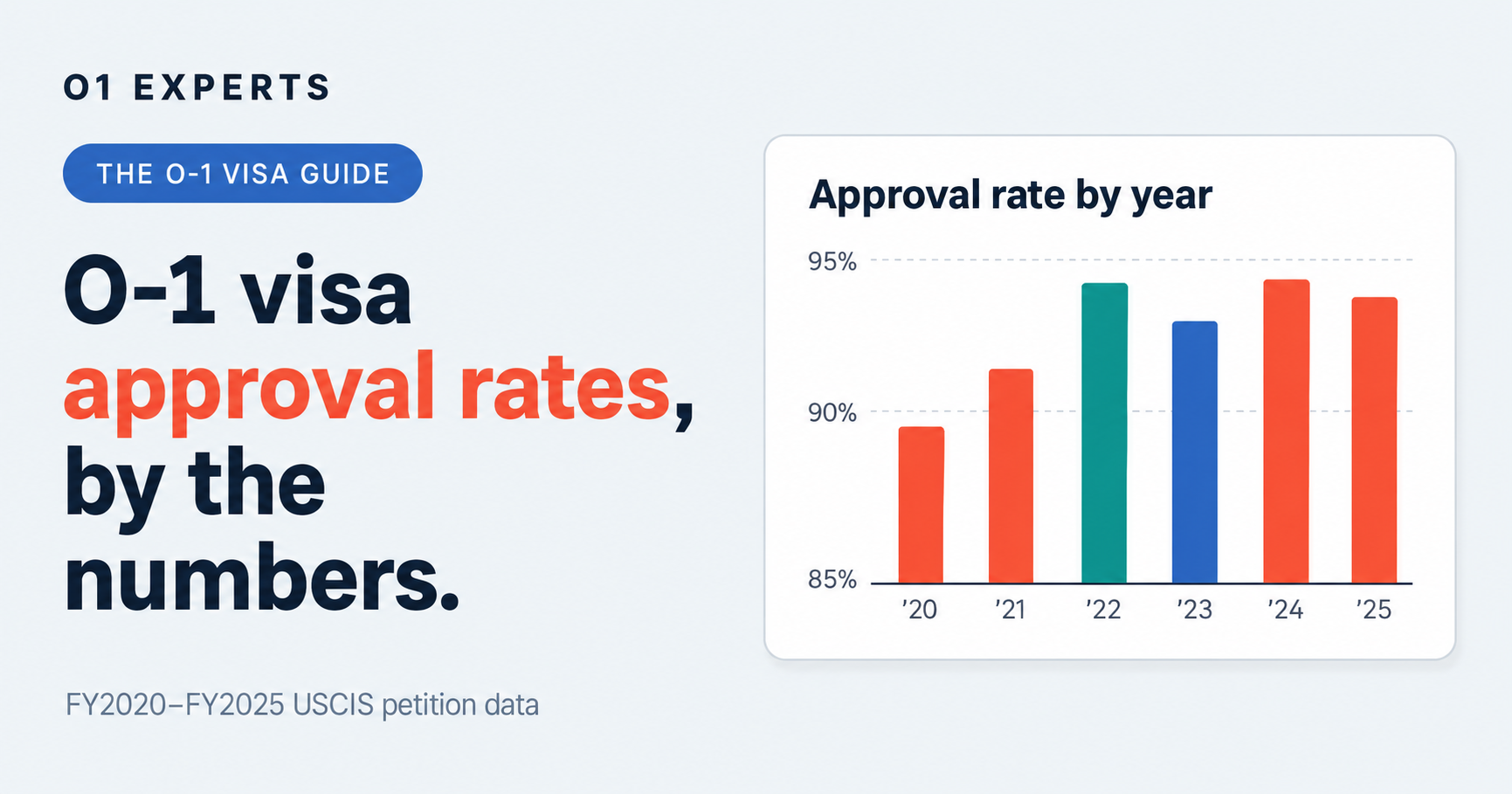
The O1 visa approval rate has remained above 90% in recent years, even as the number of petitions has increased. USCIS data shows a 93.9% approval rate for completed O-category petitions in fiscal year 2025. In the second quarter of FY2026, the rate was 91.2%.
The O1 visa approval rate has remained above 90% in recent years, even as the number of petitions has increased. USCIS data shows a 93.9% approval rate for completed O-category petitions in fiscal year 2025. In the second quarter of FY2026, the rate was 91.2%.
Those numbers are encouraging, but they do not mean an O-1 petition is easy or guaranteed to succeed. The category is reserved for people with extraordinary ability or achievement, and the national rate combines different O classifications and case types. It cannot predict the result of an individual O-1A or O-1B petition.
This guide explains the latest data, its limitations, and petition strategy.
O-1 Visa Approval Rates by Fiscal Year
USCIS publishes Form I-129 performance data for the O classification. Based on completed cases, approvals plus denials, the recent trend is:
| Fiscal year | Completed petitions | Approved | Denied | Approval rate |
|---|---|---|---|---|
| FY2020 | 22,183 | 19,903 | 2,280 | 89.7% |
| FY2021 | 21,151 | 19,329 | 1,822 | 91.4% |
| FY2022 | 27,788 | 26,291 | 1,497 | 94.6% |
| FY2023 | 28,352 | 26,425 | 1,927 | 93.2% |
| FY2024 | 28,093 | 26,535 | 1,558 | 94.5% |
| FY2025 | 31,681 | 29,733 | 1,948 | 93.9% |
| FY2026, Q1‑Q2 | 14,658 | 13,351 | 1,307 | 91.1% |
Approval rate is calculated as approvals divided by approvals plus denials. FY2026 data covers October 2025 through March 2026 and is not a full-year result.
The FY2026 second-quarter result alone was 91.2%, based on 6,915 approvals and 668 denials. That is below the FY2025 rate, but two quarters do not establish a long-term decline. Petition volume, case mix, and RFE activity can affect a quarterly result.
Completed O petitions grew from about 22,000 in FY2020 to almost 32,000 in FY2025, while approval rates stayed near or above 90%.
What the O-1 Visa Approval Rate Actually Measures
The most important limitation is hidden in the label. Public USCIS performance reports group the O classification together. They do not provide a definitive national approval rate separated into O-1A, O-1B, and O-2 petitions. They also do not consistently separate initial petitions from extensions in the headline figure.
The cases are not identical. An extension may present a different risk profile from a first petition, while O-1A and O-1B cases use different criteria. The aggregate rate describes the category; it is not a personalized probability.
It is also important to distinguish a USCIS petition approval from visa issuance. If the beneficiary is abroad and needs a visa, the person generally applies at a U.S. embassy or consulate after petition approval.
The State Department issued 8,838 O-1 visas in FY2020, 7,294 in FY2021, 19,102 in FY2022, 18,994 in FY2023, and 19,457 in FY2024, according to its nonimmigrant visa statistics. Those totals measure a different stage, exclude changes or extensions of status completed inside the United States, and may include renewals.
Are O-1 Visas Getting Harder to Obtain?
Recent data does not show a collapse in O approval rates. The rate stayed between 91.4% and 94.6% from FY2021 through FY2025.
Early FY2026 data is softer, however, and Requests for Evidence remain an important part of the picture. Roughly one-quarter of O-category adjudications received an RFE in each of the first two quarters of FY2026, compared with roughly one-fifth during the comparable period a year earlier.
An RFE is not a denial. It means USCIS wants more information before deciding the petition. It may ask for stronger proof of an award's prestige, the selectivity of a professional membership, the beneficiary's personal role in a project, the reputation of an employer, or the connection between the proposed U.S. work and the field of extraordinary ability.
A high final approval rate can coexist with close scrutiny. Petitioners should prepare as though every claim will be tested, especially when evidence fits a criterion but does not clearly demonstrate national or international recognition.
O-1A and O-1B Eligibility Requirements
O-1A classification covers extraordinary ability in the sciences, education, business, or athletics. A beneficiary may qualify through a major internationally recognized award, such as a Nobel Prize, or by satisfying at least three of eight regulatory criteria.
Those criteria cover:
- Nationally or internationally recognized prizes or awards
- Memberships that require outstanding achievement
- Published material about the beneficiary and their work
- Participation as a judge of others' work
- Original contributions of major significance
- Authorship of scholarly articles
- Employment in a critical or essential capacity for distinguished organizations
- High salary or other remuneration compared with others in the field
Checking three boxes is not necessarily the end of the analysis. USCIS evaluates the record as a whole to decide whether it demonstrates sustained national or international acclaim and shows that the beneficiary is among the small percentage at the top of the field.
O-1B covers extraordinary ability in the arts and extraordinary achievement in motion pictures or television. A major qualifying award may establish eligibility on its own.
Otherwise, the petitioner generally submits evidence satisfying at least three of six criteria, including leading or starring roles, published recognition, commercial or critical success, expert recognition, and high remuneration. Standards differ between arts and motion-picture or television cases. Comparable evidence may be allowed when a listed criterion does not readily apply.
How to Build a Stronger Evidence Package
Strong petitions connect each exhibit to a rule and explain how it proves extraordinary ability.
Map Every Document to a Criterion
Create an evidence map before drafting the petition. List the criteria the beneficiary can credibly meet, then place each award, article, contract, citation report, salary record, or project document under the relevant criterion.
If a document does not prove the required point, do not expect its prestige or length to speak for itself.
An award certificate may not prove the award is nationally recognized. Add information about the judging process, candidate pool, selection rate, past recipients, and reputable coverage. A membership card does not prove that admission requires outstanding achievement.
Show the Beneficiary's Individual Impact
Team achievements can be valuable, but the record must identify the beneficiary's contribution. Use project documentation, independent coverage, technical records, credits, revenue or audience figures, citations, and letters from knowledgeable experts to explain what the person did and why it mattered.
When claiming a critical or essential capacity, document both sides of the criterion: the beneficiary's importance and the distinguished reputation of the organization or project. A job title alone rarely establishes either point.
Include Contracts and a Credible Itinerary
An O-1 petition must be filed by a U.S. employer or agent; the beneficiary cannot self-petition. The filing normally includes a written contract or summary of an oral agreement, an explanation of the proposed work, dates and locations, and an itinerary when multiple engagements are involved.
Vague plans or documents that conflict with one another can create questions about whether the U.S. work is real, available, and within the beneficiary's area of expertise.
Use Detailed Recommendation Letters
Three to five recommendation letters is a common strategic range, not a USCIS rule. Quality matters more than the count. The best letters come from recognized experts who can explain the beneficiary's work from first-hand knowledge or informed independent review.
Each letter should identify the writer's credentials, describe specific contributions, measure impact, and compare the beneficiary with peers. Independent experts can show recognition beyond immediate employers or collaborators. Attach a concise biography or CV.
Common RFE Triggers and How to Avoid Them
Several weaknesses repeatedly invite follow-up questions:
- Generic expert letters: Praise such as "exceptional" or "world-class" carries little weight without examples, context, and objective support.
- Weak memberships: Paid or open-enrollment associations do not establish outstanding achievement merely because they are professional organizations.
- Awards without context: Explain the award's geographic reach, selection criteria, number and caliber of competitors, judging body, and prior winners.
- Media that only mentions the beneficiary: Published-material evidence should focus on the person and their work, and the petition should establish the outlet's reach and significance.
- Unclear critical roles: Show what the beneficiary was responsible for, how their work affected outcomes, and why the organization or project has a distinguished reputation.
- Thin U.S. work documentation: Align contracts, deal memos, itinerary dates, duties, and the requested validity period.
If USCIS issues an RFE, respond to every question directly. Organize the response in the same order as the notice, provide the specific missing evidence when available, and explain how each new exhibit resolves the stated concern.
More pages do not automatically create a stronger response; relevance and clarity do.
O-1 Versus H-1B: Which Strategy Fits?
The O-1 and H-1B serve different candidates. Most private-sector cap-subject H-1B filings must pass through an annual registration and selection process. The O-1 has no annual cap or lottery, but it requires a much deeper record of achievement and recognition.
For a candidate who already has strong evidence of extraordinary ability, the O-1 can offer timing flexibility and an agent structure that supports multiple engagements.
For a professional who qualifies for a specialty occupation but has not yet developed a nationally or internationally recognized profile, the H-1B may be the more realistic standard if a cap-exempt or selected filing route is available.
Neither category is universally "better." The right choice depends on the evidence, petitioning arrangement, timing, work, and long-term plans.
Processing Time and Premium Processing
The process begins when a U.S. employer or agent files Form I-129 with supporting evidence and, when required, an advisory opinion from the appropriate peer or labor organization.
Standard processing often takes several months and varies by workload and filing location. USCIS historical data reports a national median of 3.5 months for non-premium Form I-129 cases in FY2025 and 4.7 months through February of FY2026, but an individual O petition may move faster or slower.
Premium processing does not improve the legal strength of the case. For an additional $2,965 on Form I-907, USCIS must take adjudicative action within 15 business days.
That action may be an approval, denial, RFE, notice of intent to deny, or investigation, not necessarily a final approval. If USCIS issues an RFE or notice of intent to deny, a new premium-processing period begins when it receives the response.
How O1 Experts Can Help Strengthen a Filing
O1 Experts is a visa petitioner and sponsor agent for qualified O-1A and O-1B candidates. Our team reviews a candidate's background, identifies the strongest evidence categories, helps gather and organize supporting documentation, prepares the petition package, and files Form I-129 as the official petitioner when an agent structure is appropriate.
Support may include organizing awards, publications, media coverage, citation records, contracts, itineraries, and recommendation letters.
Our agent-petitioner structure can also accommodate qualifying professionals with multiple engagements who do not have a traditional single-employer sponsor. We charge a flat upfront service fee and do not take a percentage of the beneficiary's future earnings.
We are not a law firm and do not provide legal advice or legal representation. No petitioner, agent, or service provider can guarantee USCIS approval. Applicants who need legal advice should consult a licensed immigration attorney.
Frequently Asked Questions
How Difficult Is It to Get an O-1 Visa?
The final approval rate is high, but the eligibility standard is demanding. Strong candidates usually have several years of documented achievements, recognition beyond their own employer, and evidence that fits multiple regulatory criteria. A weak or poorly explained record can still be denied.
Can I Self-Petition for an O-1 Visa?
No. A U.S. employer or U.S. agent must file the petition. A business owned by the beneficiary may sometimes petition through a separate legal entity, but the filing must satisfy USCIS rules and document a real employer or agent relationship.
Are O-1 Visas Getting Harder?
The early FY2026 approval rate is below the FY2025 rate, and RFE activity has increased, suggesting closer review. Still, the rate remains above 90%, and two quarters do not establish a lasting trend.
How Many Times Can an O-1 Visa Be Extended?
There is no fixed numerical limit. USCIS may grant extensions in one-year increments when needed to continue or complete the same event or activity. A materially new event or engagement may support a new petition with a longer requested period. Updated contracts, itineraries, and evidence of continuing qualifying work are important.
Does an O-1 Guarantee a Green Card?
No. The O-1 is a temporary nonimmigrant classification. Some O-1 beneficiaries later qualify for an EB-1A extraordinary ability green card or an EB-2 national interest waiver, but each path has separate standards and requires a new filing. An approved or pending immigrant petition does not, by itself, prevent approval of an O-1 petition, but long-term immigration planning should be reviewed carefully. Learn more in our guide to moving from an O-1 visa to a green card.
Improve Your O-1 Approval Odds With Better Preparation
The national O1 visa approval rate is reassuring, but individual evidence matters more. Identify the best-supported criteria, gather independent proof, document the proposed U.S. work, and ask of every claim: "How does this establish extraordinary ability or achievement?"
If you are ready to assess your profile and build a well-organized filing, contact our O1 Experts team to request a consultation.
Tags:
Ready To Get Started?
Fill out the form and our expert team will get back to you shortly.
Office Hours
Monday - Sunday: 8AM - 8PM PST
Our Address
609 Metairie Rd
#4013
Metairie, LA 70005