
O1 Visa to Green Card: Pathways and Requirements

For professionals with extraordinary abilities currently holding O-1 status, the transition from temporary work authorization to permanent residency represents a natural progression in their U.S. immigration journey. Understanding the available pathways and strategic considerations for moving from an o1 visa to green card status can help you make informed decisions about your long-term future in the United States. The O-1 visa provides excellent temporary authorization, but permanent residency offers stability, freedom from employer sponsorship constraints, and a clear path to U.S. citizenship.
Understanding the O-1 Visa Foundation
The O-1 visa category serves as temporary nonimmigrant status for individuals who have demonstrated extraordinary ability in sciences, arts, education, business, or athletics. This classification requires substantial documentation of achievements and sustained national or international acclaim. Unlike traditional work visas, the O-1 has no annual cap, making it an attractive option for talented professionals who need U.S. work authorization.
Holders of O-1 status maintain their authorization as long as they continue working in their field of extraordinary ability. The visa can be renewed indefinitely in one-year increments, though most professionals eventually seek permanent residency for greater stability and opportunity.
The Dual Intent Advantage
One significant benefit of the O-1 classification is its recognition of dual intent. This legal concept allows you to simultaneously maintain temporary visa status while pursuing permanent residency through a green card application. You can begin the o1 visa to green card transition without jeopardizing your current status, a flexibility not available with all visa categories.
This dual intent provision means you can:
- File for adjustment of status while maintaining O-1 validity
- Travel internationally during green card processing
- Extend your O-1 visa even with a pending green card application
- Switch employers under O-1 rules while awaiting permanent residency
The O-1 visa process already requires substantial evidence of extraordinary ability, which often aligns closely with green card requirements in certain categories.
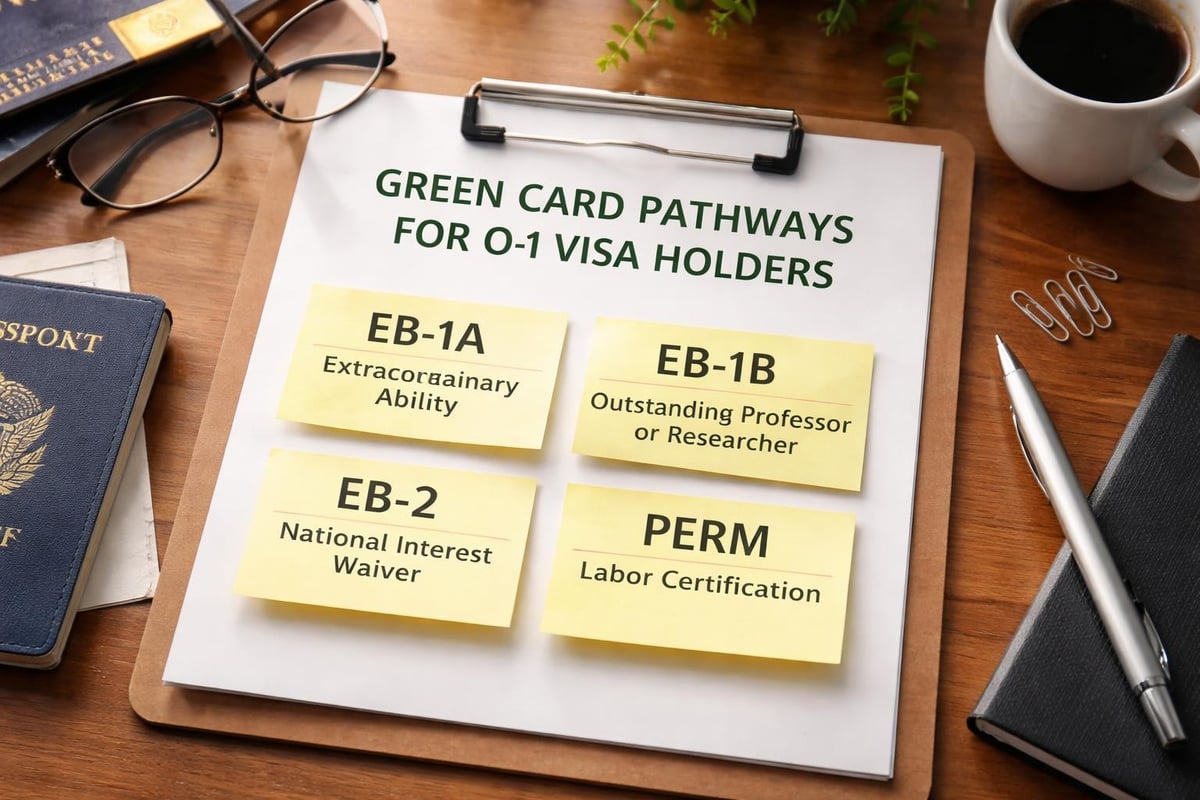
Primary Pathways from O1 Visa to Green Card
Multiple routes exist for transitioning to permanent residency, each with distinct requirements and timelines. Selecting the optimal pathway depends on your specific circumstances, field of expertise, and long-term goals.
EB-1A: Extraordinary Ability Green Card
The EB-1A category mirrors many O-1 requirements, making it the most natural transition for many visa holders. This self-petitioned green card option requires demonstrating extraordinary ability through sustained national or international acclaim. The evidentiary standards overlap significantly with O-1 criteria, though EB-1A generally requires a slightly higher threshold of achievement.
| Criterion | O-1 Standard | EB-1A Standard |
|---|---|---|
| Evidence types needed | 3 out of 8 criteria | 3 out of 10 criteria |
| Acclaim level | National or international | National or international |
| Self-petition allowed | No | Yes |
| Employer required | Yes | No |
| Processing category | Nonimmigrant | Immigrant (first preference) |
The EB-1A green card offers the advantage of self-petition, meaning you do not need employer sponsorship. This independence provides significant flexibility in your career choices and eliminates the need for labor certification.
To qualify for EB-1A status, you must provide evidence meeting at least three of ten criteria, such as:
- Receipt of major internationally recognized awards
- Membership in associations requiring outstanding achievements
- Published material about you in professional or major media
- Original contributions of major significance to your field
- Authorship of scholarly articles
- Display of your work at artistic exhibitions
- Leading or critical role in distinguished organizations
- Command of high salary compared to others in your field
EB-1B: Outstanding Professors and Researchers
Academic professionals may find the EB-1B category particularly suitable. This classification requires at least three years of experience in teaching or research, along with international recognition for outstanding achievements in your academic field. Unlike EB-1A, EB-1B requires employer sponsorship from a university or research institution offering a permanent position.
The evidence requirements for EB-1B include demonstrating at least two of six specific criteria related to academic achievement. This pathway works exceptionally well for university faculty, research scientists, and scholars with established publication records and recognition within their academic communities.
EB-2 National Interest Waiver (NIW)
The National Interest Waiver under the EB-2 category provides another self-petition option for professionals whose work benefits U.S. national interests. This pathway requires an advanced degree or exceptional ability, along with evidence that your proposed endeavor has substantial merit and national importance. According to comprehensive guidance on transitioning from O-1 visa to green card, the NIW allows you to waive the labor certification requirement by demonstrating your work serves U.S. interests.
The three-prong test for NIW includes:
- Your proposed endeavor has substantial merit and national importance
- You are well positioned to advance the proposed endeavor
- It would be beneficial to the United States to waive job offer and labor certification requirements
This option suits entrepreneurs, researchers, and professionals working in fields like technology, healthcare, renewable energy, or education where their contributions clearly benefit the nation.
Employment-Based PERM Process
Traditional employment-based green cards through PERM labor certification remain available, though they involve more steps and employer dependency. The EB-2 and EB-3 categories require your employer to demonstrate no qualified U.S. workers are available for the position through a formal recruitment process.
While this pathway takes longer and requires substantial employer cooperation, it provides a reliable route for professionals who may not meet the extraordinary ability or national interest standards. The process typically takes 18-36 months depending on your country of birth and priority date.
Strategic Timing and Planning Considerations
Deciding when to begin your o1 visa to green card transition requires careful analysis of multiple factors. Starting the process early maximizes your options and provides security against potential visa complications.
When to Start Your Green Card Application
Most immigration attorneys recommend beginning your green card process as soon as you qualify, even if you plan to maintain O-1 status for several more years. The dual intent provision allows you to pursue both simultaneously without conflict.
Consider initiating your green card application when:
- You have accumulated sufficient evidence of extraordinary ability
- Your career achievements demonstrate sustained acclaim
- You anticipate remaining in the United States long-term
- You want freedom from employer-dependent visa restrictions
- Priority dates in your category show reasonable processing times
Early filing provides insurance against policy changes and establishes your place in line for visa number allocation.
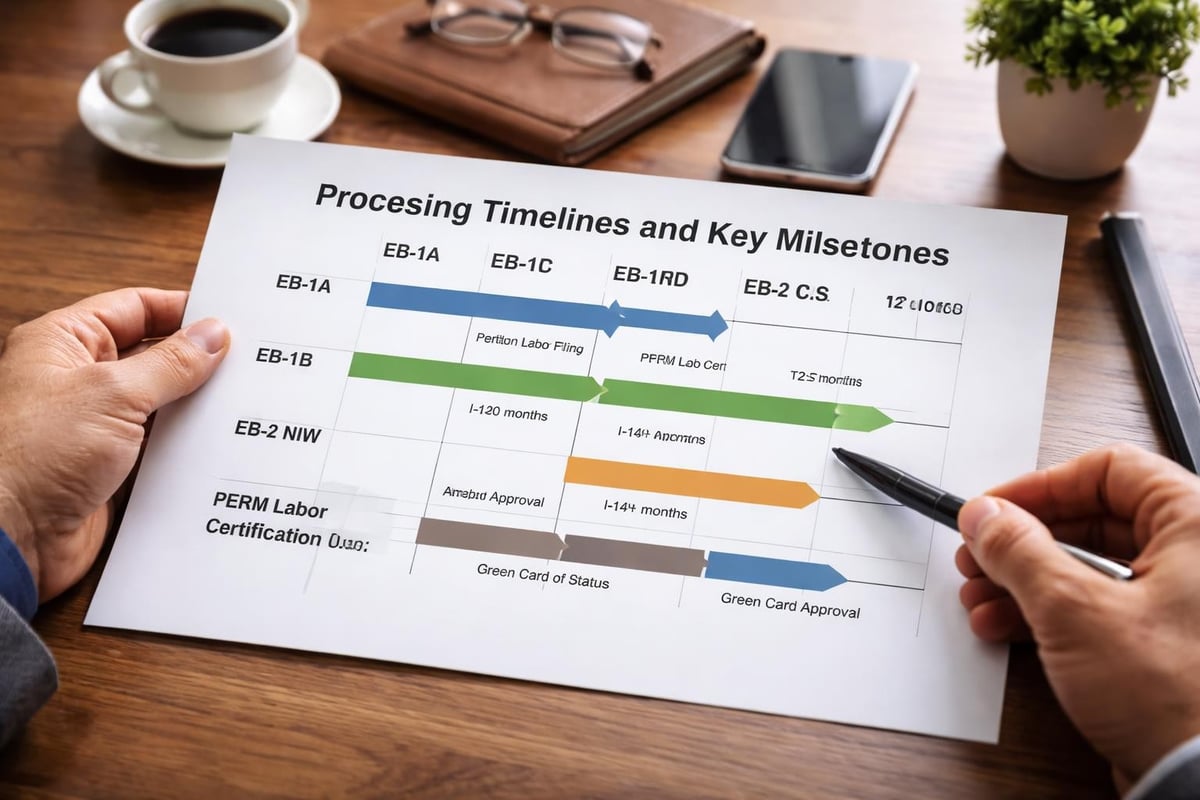
Processing Times and Priority Dates
Understanding current processing times helps set realistic expectations for your permanent residency timeline. The comprehensive O-1 visa guide notes that EB-1 categories generally offer the fastest processing as first-preference immigrant visas.
| Green Card Category | Average Processing Time | Premium Processing Available |
|---|---|---|
| EB-1A | 12-18 months | No (discontinued in 2021) |
| EB-1B | 12-18 months | No |
| EB-2 NIW | 18-30 months | No |
| EB-2/EB-3 PERM | 24-48 months | No |
These timelines represent estimates and vary based on USCIS service center, your country of birth, and current visa bulletin allocations. Nationals of countries with high immigration volumes may face additional wait times due to per-country limitations.
Maintaining Status During Transition
Throughout the green card process, maintaining valid O-1 status protects your ability to work and remain in the United States legally. Never allow your O-1 authorization to lapse, even with a pending green card application, until you receive your Employment Authorization Document (EAD) or adjustment of status approval.
Best practices for status maintenance include:
- File O-1 extensions 6-8 months before expiration
- Keep meticulous records of all immigration filings
- Maintain employment in your field of extraordinary ability
- Document continued achievements and recognition
- Consult with immigration counsel before job changes
Working with specialists who understand both O-1 visa requirements and green card processes ensures seamless transitions between status categories.
Evidence Building and Documentation
Success in transitioning from o1 visa to green card status depends heavily on compelling evidence documentation. The materials you compiled for your O-1 petition provide an excellent foundation, but green card applications typically require additional depth and breadth of proof.
Strengthening Your Evidence Portfolio
Your green card evidence should demonstrate not just past achievements but ongoing contributions and increasing recognition in your field. Focus on recent accomplishments that occurred after your O-1 approval to show sustained extraordinary ability.
Key evidence categories include:
- Publications and citations: Journal articles, books, patents, or creative works with documented impact
- Media coverage: Features in professional or major trade publications discussing your contributions
- Awards and honors: Recognition from professional organizations or government entities
- Critical role evidence: Documentation of leadership positions or essential contributions to significant projects
- Expert letters: Detailed testimonials from respected authorities in your field
- Judging work: Evidence of peer review activities or competition judging
- Financial documentation: Proof of high compensation relative to field standards
The detailed guide on O-1 visa and EB-1 green card differences emphasizes that while the criteria overlap, green card applications benefit from showing broader impact and sustained recognition over time.
Letters of Recommendation
Expert recommendation letters play a crucial role in both O-1 and green card applications, but the approach differs slightly. For permanent residency, letters should emphasize:
- The enduring significance of your contributions to the field
- How your continued presence in the United States benefits the nation
- Your unique qualifications that distinguish you from peers
- Specific examples of your extraordinary ability in action
- Your potential for future contributions and leadership
Ideal recommenders include internationally recognized experts, university department chairs, industry leaders, or government officials familiar with your work. Diversity in recommender backgrounds strengthens your application by demonstrating broad recognition across different sectors of your field.
Cost Considerations and Financial Planning
Transitioning from an O-1 visa to permanent residency involves significant financial investment beyond the initial visa costs. Understanding the complete financial picture helps you plan appropriately and avoid surprises during the process.
Application Fees and Legal Costs
Government filing fees represent just one component of total expenses. As of 2026, expect these approximate costs:
- I-140 Immigrant Petition: $700-$1,000 (depending on category)
- I-485 Adjustment of Status: $1,140 (plus $85 biometrics)
- Medical Examination: $200-$500
- EAD and Advance Parole: Included with I-485 filing
- Attorney Fees: $5,000-$15,000 (varies by complexity and location)
Additional costs may include translation services for foreign documents, credential evaluations, expert witness fees, and expedited document preparation. According to resources on cost considerations, comprehensive green card applications typically range from $8,000 to $20,000 total when including legal representation.
Employer Sponsorship vs. Self-Petition
The financial responsibility for green card processing may fall on you, your employer, or be shared depending on the pathway you choose. Self-petition categories (EB-1A, EB-2 NIW) give you complete control but require you to cover all expenses.
Employer-sponsored pathways may include company-paid legal fees and filing costs, particularly for PERM labor certification processes. However, this creates dependency on your employer and may restrict job mobility during processing. Many professionals prefer self-petition routes despite higher personal costs for the freedom and control they provide.

Family Benefits and Derivative Status
One often-overlooked advantage of permanent residency involves expanded benefits for family members compared to O-1 dependent status. Understanding these differences can significantly impact your decision-making timeline.
O-3 Dependents vs. Green Card Derivatives
Under O-1 status, your spouse and unmarried children under 21 receive O-3 dependent visas. However, O-3 dependents cannot work in the United States, which represents a significant limitation for many families. They can study but must maintain their dependent status tied to your O-1 validity.
Green card derivatives receive immediate work authorization upon approval of their I-485 applications or earlier through EAD applications filed concurrently. This flexibility allows spouses to pursue careers without separate work visa sponsorship and provides families with dual-income capability and career advancement opportunities.
| Status Type | Work Authorization | Study Permitted | Travel Flexibility |
|---|---|---|---|
| O-3 Dependent | Not permitted | Yes | Limited to O-3 validity |
| Green Card Derivative | Immediate upon approval | Yes | Re-entry permit available |
| EAD During AOS | Permitted after 90-180 days | Yes | Advance Parole required |
Children who age out (turn 21) during green card processing receive protection under the Child Status Protection Act in certain circumstances, but proactive planning helps avoid complications. Information about O-1 spouse visa considerations provides additional context for family planning during the transition.
Premium Processing and Expedite Options
While premium processing for green card applications remains unavailable as of 2026, certain circumstances may qualify for expedited processing. USCIS considers expedite requests based on severe financial loss, emergency situations, humanitarian reasons, nonprofit organization interests, or Department of Defense or national interest situations.
Most applicants should plan for standard processing timelines rather than relying on expedite possibilities. Building buffer time into your planning accounts for potential delays and prevents status gaps.
Alternative Pathways and Special Circumstances
Not all situations fit neatly into standard categories. Several alternative approaches may suit specific professional circumstances or fields.
EB-1C Multinational Manager or Executive
Professionals in management positions with international companies may qualify for EB-1C green cards. This category requires employment abroad with the same company or affiliate for at least one year within the past three years, plus a U.S. position in a managerial or executive capacity.
While less common for typical O-1 holders, this pathway works well for business executives and managers with qualifying multinational experience who may not meet extraordinary ability standards.
Concurrent I-140 and I-485 Filing
When visa numbers are immediately available in your category and country of chargeability, you can file your I-140 immigrant petition and I-485 adjustment of status simultaneously. Concurrent filing accelerates the overall timeline by several months and provides faster access to work authorization through EAD.
This strategy works particularly well for EB-1 applicants from most countries, as first preference categories generally maintain current priority dates. Check the monthly visa bulletin to confirm availability before filing.
Consular Processing vs. Adjustment of Status
O-1 holders have the option to process their green cards through adjustment of status (if in the United States) or consular processing (through a U.S. embassy abroad). Each approach has distinct advantages and considerations.
Adjustment of status allows you to remain in the United States throughout processing and provides interim work authorization. Consular processing may be faster in some cases and works better for applicants who spend significant time abroad or have complex immigration histories.
The guide to O-1 visa travel and renewal procedures discusses travel considerations during green card processing that influence this choice.
Common Challenges and Problem-Solving
Even well-prepared applications encounter obstacles. Recognizing potential challenges and developing mitigation strategies increases success rates.
Requests for Evidence (RFEs)
USCIS may issue RFEs requesting additional documentation or clarification on specific aspects of your application. Approximately 40-50% of I-140 petitions receive RFEs, so preparation for this possibility is wise.
Common RFE topics include:
- Insufficient evidence of sustained acclaim or extraordinary ability
- Questions about the significance of contributions to the field
- Requests for more detailed expert letters
- Documentation of comparable achievements to claimed awards
- Clarification of roles and responsibilities in claimed positions
Responding comprehensively and within the deadline (typically 87 days) preserves your filing date and prevents denials. Working with experienced immigration professionals ensures thorough RFE responses that address USCIS concerns completely.
Priority Date Retrogression
Applicants from countries with high immigration volumes (particularly India and China) may face priority date backlogs even in EB-1 categories during periods of high demand. While EB-1 generally remains current, monitoring the monthly visa bulletin helps you understand potential wait times.
Approved I-140 petitions establish your priority date, which you can retain even if you change employers or file in a different category. This portability provides valuable flexibility in your long-term immigration strategy.
Maintaining Extraordinary Status
Throughout the o1 visa to green card process, continue building your credentials and maintaining extraordinary ability status. Green card adjudicators review evidence up through the final decision, so ongoing achievements strengthen your application even after filing.
Document new publications, awards, speaking engagements, media coverage, and professional recognition as they occur. These supplementary materials can be submitted proactively or in response to RFEs to demonstrate continued excellence in your field.
Post-Approval Considerations
Receiving green card approval marks a significant milestone, but understanding your new rights and responsibilities ensures you maintain permanent resident status properly.
Conditional vs. Permanent Status
Most employment-based green cards grant immediate permanent status without conditions. However, marriage-based derivatives may receive conditional two-year green cards requiring removal of conditions, depending on timing relative to the marriage.
Permanent residents must maintain residence in the United States and avoid absences exceeding 180 days without advance planning. Lengthy trips abroad may trigger abandonment presumptions, though re-entry permits allow for extended international travel when necessary.
Path to Citizenship
Green card holders become eligible to apply for U.S. citizenship through naturalization after five years of permanent residence (or three years if married to a U.S. citizen). This final step provides complete freedom from immigration status concerns and full participation in American civic life.
The journey from building a strong O-1 application through permanent residency to eventual citizenship represents a multi-year commitment requiring strategic planning and persistent documentation of achievements.
Career Flexibility Benefits
One of the greatest advantages permanent residents gain is complete career flexibility. Unlike O-1 status, which requires working in your field of extraordinary ability for your sponsoring employer, green card holders can:
- Change employers without immigration filings or approvals
- Switch careers or industries entirely
- Start businesses or work as independent contractors
- Take time off between jobs without status concerns
- Pursue additional education or training freely
This freedom represents the primary motivation for many professionals pursuing the o1 visa to green card transition, despite the complexity and expense involved in the process.
Transitioning from O-1 status to permanent residency requires strategic planning, thorough documentation, and understanding of multiple pathway options available to professionals with extraordinary ability. Whether you pursue EB-1A self-petition, EB-2 National Interest Waiver, or another route, early preparation and expert guidance maximize success rates. O1 Experts specializes in helping professionals navigate both O-1 visa applications and the transition to permanent residency, providing comprehensive support through eligibility assessment, evidence compilation, and strategic application planning tailored to your unique achievements and career goals.
Ready To Get Started?
Fill out the form and our expert team will get back to you shortly.
Office Hours
Monday - Sunday: 8AM - 8PM PST
Our Address
609 Metairie Rd
#4013
Metairie, LA 70005