
Benefits of an H-1B Visa for Employers and Workers
The H-1B visa is one of the best-known employment-based options for foreign nationals who want to work in the United States. It allows U.S. employers to hire qualified workers for specialty occupations that require highly specialized knowledge and, generally, at least a bachelor's degree or equivalent in a directly related specialty.
The H-1B visa is one of the best-known employment-based options for foreign nationals who want to work in the United States. It allows U.S. employers to hire qualified workers for specialty occupations that require highly specialized knowledge and, generally, at least a bachelor's degree or equivalent in a directly related specialty. Fields can range from engineering and technology to medicine, education, accounting, architecture, and other professional areas.
The benefits of H-1B visa status extend to both workers and employers. Professionals gain lawful work authorization, potential pathways toward permanent resident status, options for bringing qualifying family members to the U.S., and some flexibility as their careers evolve. Employers gain access to specialized talent that can help fill difficult positions.
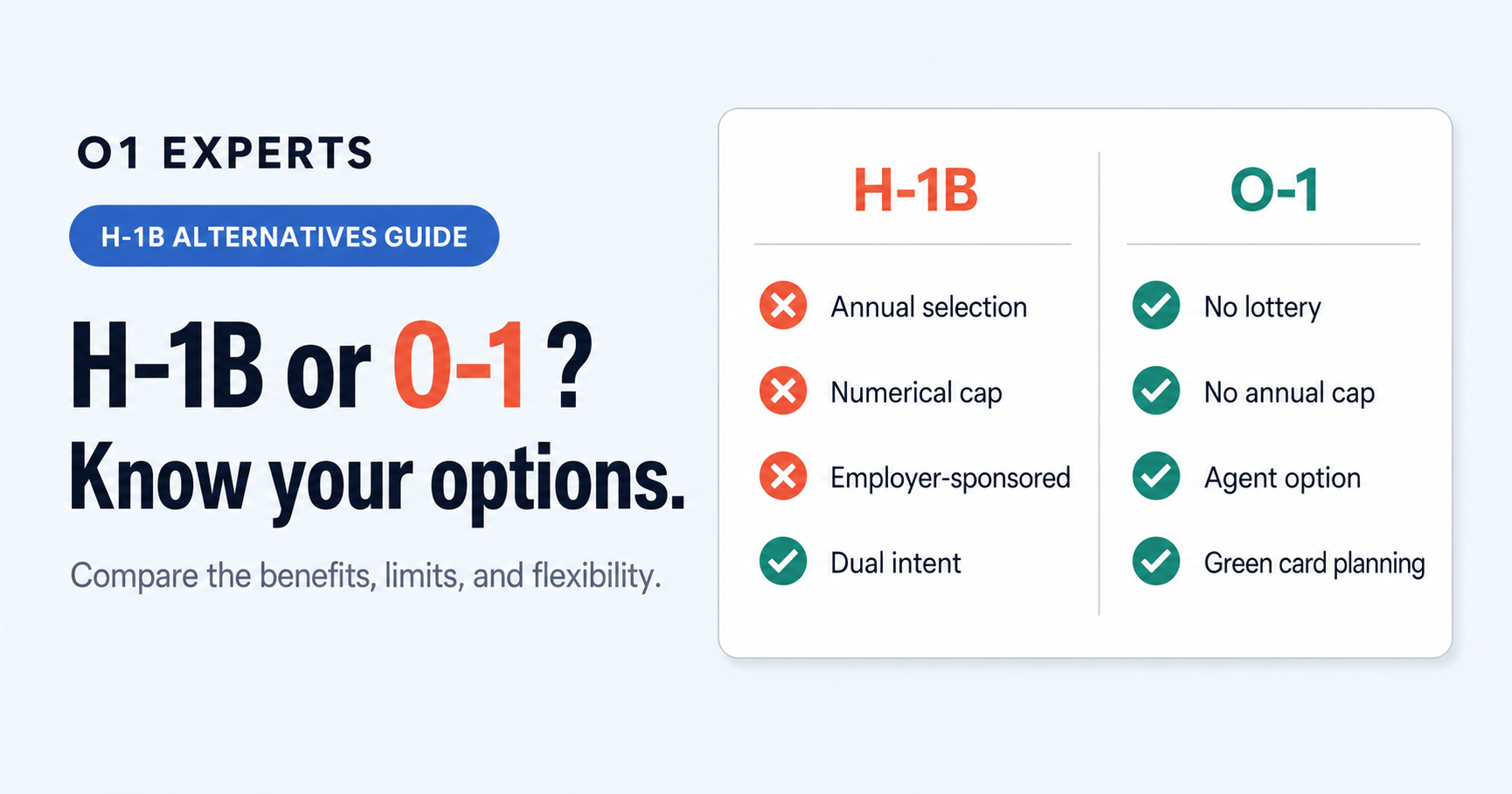
Still, H-1B status comes with limitations. Many applicants face an annual cap and selection process, and employment remains tied to qualifying sponsorship. Accomplished professionals may also have alternatives, including O-1A, O-1B, or EB-1A.
Understanding the advantages and drawbacks can help you decide where the H-1B fits into your U.S. career strategy.
How Does an H-1B Visa Benefit Foreign Workers?
For many foreign nationals, H-1B status provides an opportunity to build a professional career while retaining options for the future. Along with authorization to work for a petitioning employer, the classification offers benefits involving career mobility, family members, wage protections, and long-term immigration planning.
Those advantages can make H-1B status valuable for professionals who want more than a short-term U.S. work opportunity.
H-1B Status Provides Work Authorization and Supports Long-Term Immigration Goals
Typically, H-1B employment authorization is tied to the petitioning employer and the position described in the approved petition. However, one of the classification's major advantages is dual intent, which allows H-1B workers to pursue permanent residence while maintaining their temporary H-1B status.
In practical terms, dual intent means an H-1B worker does not have to demonstrate an intention to leave the United States at the end of their temporary stay simply because they are applying for permanent residence. They can take steps toward an employment-based green card without that goal conflicting with their H-1B status.
H-1B petitions can ordinarily be approved for an initial period of up to three years, with extensions usually available for another three years. Some workers may also qualify to remain in H-1B status past the usual six-year limit when they reach qualifying stages of the employment-based green-card process.
For professionals with long-term U.S. career plans, this combination of temporary work authorization, dual intent, and potential green-card opportunities is one of the H-1B's most valuable advantages.
Can H-1B Workers Change Employers or Work for Multiple Companies?
An H-1B doesn't necessarily lock you into the same employer for your entire period of U.S. employment.
Under H-1B portability provisions, an eligible worker changing H-1B employers may begin working for the new employer once that employer properly files Form I-129, provided applicable requirements are met.
Concurrent H-1B employment may also allow a professional to work for more than one employer when each employment relationship is supported by the appropriate petition.
This flexibility can be valuable when a better career opportunity appears. However, H-1B authorization remains tied to approved employment. Material changes involving duties, work locations, or other employment conditions can create additional immigration requirements, so job changes should be evaluated before they happen.
Can Your Spouse or Children Come with on an H-1B Visa?
Qualifying spouses and unmarried children under 21 can typically accompany an H-1B worker in H-4 status.
Employment rights for H-4 spouses are more limited. Some spouses can apply for an Employment Authorization Document when the H-1B principal beneficiary has an approved Form I-140 or has received H-1B status under qualifying provisions of the American Competitiveness in the Twenty-first Century Act.
This distinction matters. H-4 status itself does not automatically give every spouse permission to work, so families should understand their individual circumstances when planning a move to the U.S.
What Wage Protections Do H-1B Workers Receive?
The H-1B program includes wage and working-condition protections.
Employers generally must pay the higher of the actual wage paid to similarly qualified workers or the applicable prevailing wage for the occupation and area of employment. Employers must also provide working conditions and fringe benefits on the same basis as similarly employed U.S. workers.
These rules make the Labor Condition Application, or LCA, an important part of H-1B sponsorship. Workers should maintain employment records, pay statements, and other documentation related to their position. Employers have corresponding recordkeeping and compliance obligations.
How Does H-1B Sponsorship Benefit U.S. Employers?
For U.S. employers, H-1B sponsorship provides access to professionals with specialized education, knowledge, and experience.
That can be valuable when recruiting for technical, scientific, medical, financial, engineering, and other specialized positions. Instead of limiting recruitment to candidates who already possess unrestricted U.S. work authorization, employers can consider qualified professionals from a broader talent pool.
Organizations that frequently recruit internationally can also incorporate immigration into long-term workforce planning. Identifying sponsorship needs early gives HR teams, hiring managers, and candidates more time to understand filing requirements and employment timelines.
Not every H-1B petition is subject to the annual cap. USCIS notes that some employers, including qualifying U.S. institutions of higher education, can be cap exempt. Employers that may qualify should evaluate that possibility before assuming the annual cap process applies.
How Does the H-1B Process Work and How Long Can It Take?
For cap-subject employment, timing is a major consideration.
Prospective employers first electronically register beneficiaries during the USCIS registration period. Starting with FY 2027, USCIS uses a weighted selection process if registrations exceed available numbers, with selection often based on the highest qualifying Occupational Employment and Wage Statistics wage level. Only employers with selected registrations can file cap-subject petitions for those beneficiaries.
Selection is not approval. It provides an opportunity to file the full H-1B petition.
Employers and candidates can use the time before filing to organize degree records, job descriptions, employment documentation, credential evaluations when applicable, and evidence connecting the candidate's qualifications to the specialty occupation.
Premium processing can expedite USCIS action on eligible petitions for an additional fee, but faster processing does not mean automatic approval. USCIS may approve the petition, issue a Request for Evidence, deny it, or take another qualifying adjudicative action.
What Costs and Responsibilities Do H-1B Employers Have?
H-1B sponsorship involves filing expenses and ongoing compliance responsibilities. Depending on the employer and petition, these may include:
- Form I-129 filing fees and other applicable USCIS charges
- Fraud Prevention and Detection Fee for qualifying petitions
- ACWIA fee based on applicable employer requirements
- Asylum Program Fee when required
- Premium processing fee if expedited processing is requested
- LCA documentation and notices related to wages and working conditions
- Public Access File records that must be maintained and made available as required
Employers should also understand which costs they are responsible for paying. H-1B workers cannot be required to pay the USCIS petition filing fee or employer business expenses, such as attorney fees associated with preparing and filing the LCA, when doing so would violate Department of Labor requirements.
Compliance doesn't end when USCIS approves the petition. Employers need to continue meeting applicable wage, notice, documentation, and working-condition requirements throughout the H-1B employment period.
What Are the Drawbacks of the H-1B Visa?
For cap-subject workers, availability remains a major limitation. The annual H-1B cap generally includes 65,000 visas under the regular cap, with an additional 20,000 available under the U.S. advanced-degree exemption. When demand exceeds the available numbers, qualified workers can still face uncertainty about their ability to move forward.
Timing can also restrict employers and candidates. Cap-subject employment follows the annual registration and filing cycle, which may not align with an immediate hiring need.
There may also be the six-year H-1B limit to consider, although qualifying green-card cases can create exceptions. Employment changes may require additional filings as well.
H-1B rules have also experienced significant recent changes, including changes to the selection process and litigation involving an additional $100,000 payment requirement for some petitions. As of July 28, 2026, USCIS stated that it was complying with a federal court order affecting that payment while DHS considered next steps.
H-1B rules and filing procedures can change, making it important to review current requirements before building your immigration timeline.
What Are the Alternatives to an H-1B Visa?
The H-1B isn't the only way to pursue professional opportunities in the U.S. Depending on your accomplishments, nationality, employment history, and long-term plans, another visa category may be a better fit.
- O-1A: Designed for individuals with extraordinary ability in science, education, business, or athletics. Unlike the cap-subject H-1B, the O-1A does not depend on an annual lottery.
- O-1B: Available to qualifying individuals with extraordinary ability in the arts or extraordinary achievement in motion pictures or television.
- EB-1A: An immigrant classification for individuals with extraordinary ability that can provide a potential route to permanent residency rather than temporary nonimmigrant status.
- TN, L-1, or E-2: Other potential options depending on factors such as nationality, employment history, company structure, investment activity, and career plans.
O-1 eligibility depends heavily on the strength of your professional record. Depending on the category, evidence might include awards, press coverage, original contributions, judging experience, high compensation, significant professional positions, publications, or commercial success.
Could an O-1 Visa Be a Better Fit for Your Career?
The H-1B offers several advantages for workers and employers, but it isn't the best fit for every situation.
If you have a strong record of achievement, the H-1B may not be your only path. For those who meet O-1 eligibility requirements, avoiding the annual H-1B cap can be a meaningful advantage. The O-1 visa can also provide flexibility through a U.S. agent structure for qualifying individuals working across multiple engagements.
See Which Visa Path Fits Your Achievements
At O1 Experts, we help accomplished individuals determine which immigration path aligns with their experience and plans. Our team assists with O-1A as well as EB-1A green card cases, helping clients build a strategy around their career and timeline.
Think you may qualify? Book a free consultation with our team to discuss your next steps.
Tags:
Ready To Get Started?
Fill out the form and our expert team will get back to you shortly.
Office Hours
Monday - Sunday: 8AM - 8PM PST
Our Address
609 Metairie Rd
#4013
Metairie, LA 70005