
O1 B Visa: Complete Guide for Creative Professionals

The O1 B visa represents a specialized immigration pathway for creative professionals who have demonstrated distinction in their fields. Unlike the O-1A category that focuses on sciences, education, business, and athletics, the 01 b visa specifically serves individuals in the arts, motion picture, and television industries who have achieved recognition for their exceptional accomplishments. This nonimmigrant visa classification allows talented artists, performers, directors, designers, and other creative professionals to live and work in the United States while contributing their extraordinary talents to American cultural and entertainment sectors.
Understanding the O1 B Visa Classification
The 01 b visa falls under the broader O-1 visa category administered by USCIS, specifically designed for individuals whose achievements have been recognized through distinction. The term "distinction" holds particular significance in this context. It means a high level of achievement evidenced by a degree of skill and recognition substantially above what is ordinarily encountered in the motion picture or television industry.
Key characteristics of the O1 B visa include:
- Validity periods typically granted for up to three years initially
- Unlimited extensions available in one-year increments
- No annual cap or lottery system, unlike H-1B visas
- Flexibility to work for multiple employers with proper petition amendments
- Ability to transition to permanent residency without jeopardizing status
Who Qualifies for an O1 B Visa
The 01 b visa serves creative professionals across diverse artistic disciplines. Eligible individuals include actors, musicians, dancers, choreographers, film directors, cinematographers, producers, set designers, costume designers, makeup artists, sound engineers, and other professionals in the entertainment and arts industries.
To qualify, applicants must demonstrate distinction in their field. This differs from the "extraordinary ability" standard required for O-1A visa holders, making the 01 b visa somewhat more accessible to accomplished creative professionals who may not yet have reached the pinnacle of their industries.
Establishing Distinction: Evidence Requirements
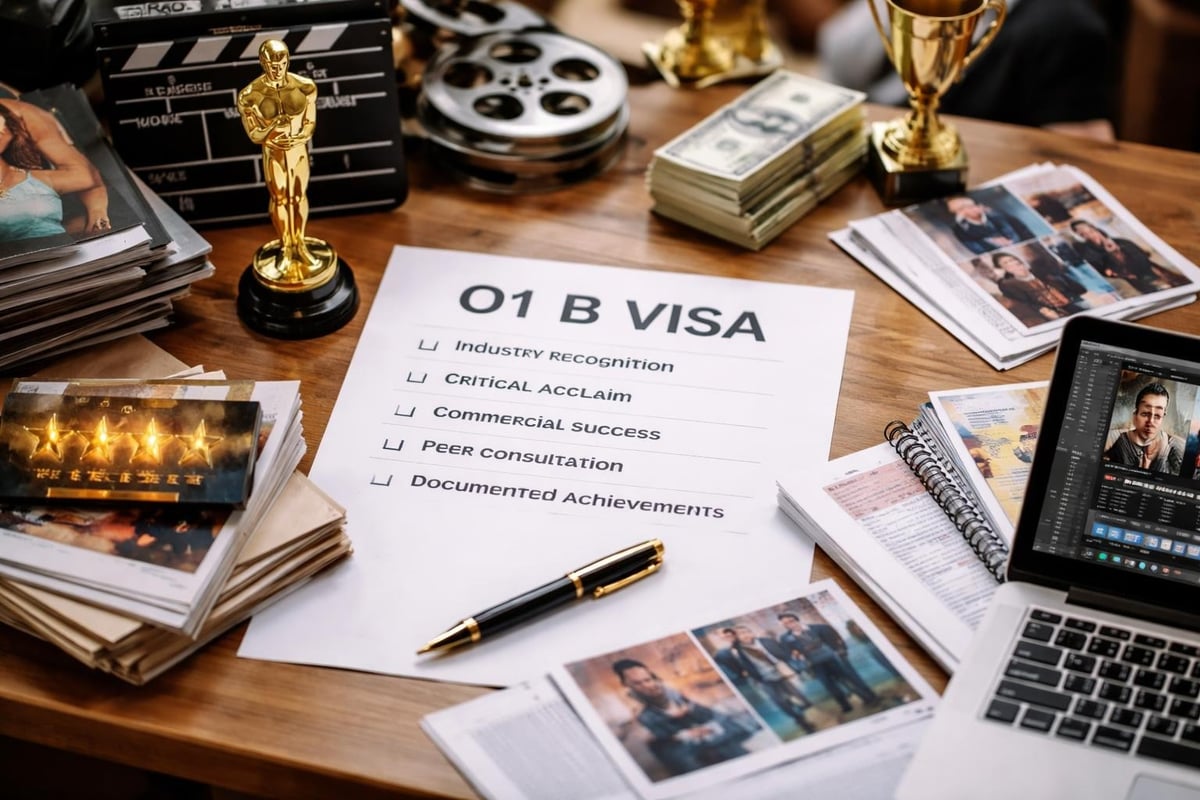
The 1 b visa application requires comprehensive documentation proving the applicant's distinction. USCIS evaluates applications based on specific evidentiary criteria, and applicants must satisfy at least three of the following categories to demonstrate their qualification.
Primary Evidence Categories
Awards and Recognition Documentation of nominations or awards from recognized organizations demonstrates peer recognition. These can include Emmy nominations, Grammy Awards, Tony Awards, Academy Awards, or significant industry-specific honors. Even regional or specialized awards carry weight when they represent meaningful recognition within the applicant's particular niche.
Critical Reviews and Published Materials Published materials about the applicant in major trade publications, newspapers, or professional journals establish public recognition. Reviews, features, interviews, and critical commentary from respected sources help build the case for distinction. The quality and reach of these publications matter significantly in the evaluation process.
High Salary or Remuneration Evidence that the applicant commands a high salary relative to others in the field supports the distinction claim. This can include contracts, tax returns, payment statements, or industry salary surveys demonstrating compensation substantially above the norm.
| Evidence Type | Examples | Strength Factor |
|---|---|---|
| Major Awards | Emmy, Grammy, Tony nominations | Very High |
| Critical Reviews | Trade publications, major newspapers | High |
| High Compensation | Contracts showing top-tier rates | High |
| Leading Roles | Starring or critical positions | Medium-High |
| Membership | Exclusive professional organizations | Medium |
Supporting Documentation
Lead or Critical Roles Documentation proving the applicant performed lead, starring, or critical roles for distinguished organizations strengthens applications. This includes program credits, contracts, promotional materials, and organizational statements confirming the importance of the applicant's contributions.
Commercial Success Evidence of commercial success can include box office receipts, television ratings, album sales, streaming numbers, ticket sales, or other measurable indicators that the applicant's work has achieved significant market success.
Recognition from Organizations and Experts Testimonials from recognized experts, organizations, or peers in the field carry substantial weight. Letters should come from individuals with established credibility who can speak knowledgeably about the applicant's achievements and standing within the industry.
The Application Process for an O1 B Visa
Navigating the 01 b visa application requires careful preparation and attention to procedural requirements. Understanding each step ensures a smoother process and higher approval likelihood.
Securing a U.S. Sponsor
Unlike self-petitioning green card categories like the EB-1A, the 01 b visa requires a U.S. sponsor. This sponsor can be an employer, agent, or U.S. entity that will engage the beneficiary's services. The sponsor relationship must be genuine and supported by contractual agreements.
For creative professionals working with multiple clients or on various projects, an agent can serve as the petitioner, providing flexibility for freelance and project-based work arrangements. This arrangement allows performers and artists to accept multiple engagements without requiring separate petitions for each employer.
Advisory Opinion Requirement
A distinctive feature of the 01 b visa process is the mandatory advisory opinion from an appropriate peer group or labor organization. This consultation letter must come from a recognized organization with expertise in the applicant's field.
The advisory opinion must address:
- The nature of the work to be performed
- The applicant's qualifications and standing in the field
- Whether the position requires someone of the applicant's caliber
- The organization's assessment of the applicant's distinction
Some fields have established organizations that regularly provide these opinions, while others require identifying appropriate peer groups. Planning for this requirement well in advance prevents delays, as some organizations take weeks to process requests.
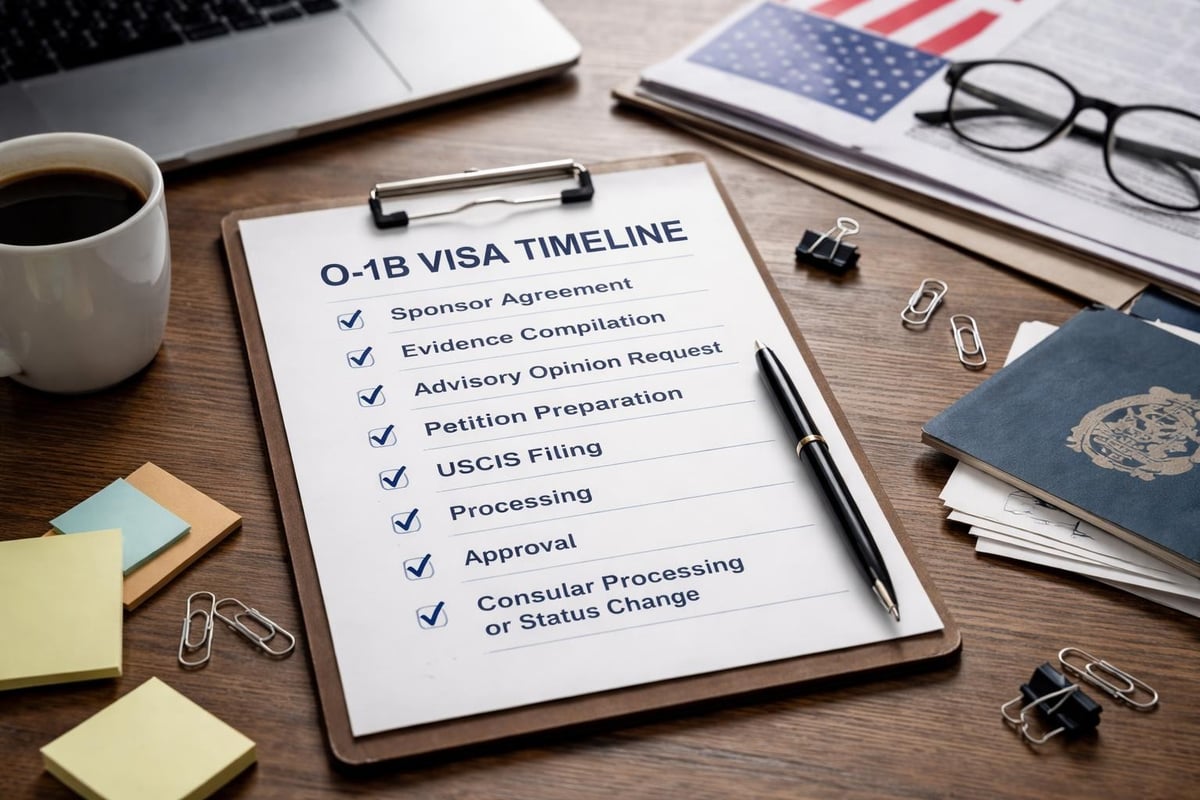
Preparing the Petition Package
The Form I-129, Petition for a Nonimmigrant Worker, serves as the foundation for the 01 b visa application. This comprehensive petition must include all supporting documentation, the advisory opinion, evidence of the beneficiary's distinction, and detailed information about the employment arrangement.
- Complete Form I-129 with O-1B supplement
- Gather all evidence of distinction across multiple categories
- Obtain advisory opinion from appropriate peer organization
- Prepare detailed itinerary of events or description of services
- Include copies of contracts or employment agreements
- Submit petition to appropriate USCIS service center
Premium processing is available for an additional fee, reducing the processing time from several months to 15 calendar days. This expedited service proves valuable when project timelines demand quicker approval.
Duration and Extensions for the O1 B Visa
The initial 01 b visa period can be approved for up to three years, depending on the time needed to accomplish the intended events or activities. USCIS determines the appropriate period based on the itinerary and contracts submitted with the petition.
Extension Procedures
Extensions follow a straightforward process when the visa holder continues performing at a distinguished level. Each extension can be granted in one-year increments with no maximum limit, allowing creative professionals to maintain their status indefinitely as long as they continue qualifying work.
Extension applications require:
- Updated evidence of continued distinction
- New contracts or itinerary showing ongoing work
- Demonstration that the original basis for classification remains valid
- Form I-129 with appropriate fees
The absence of a maximum duration makes the 01 b visa particularly attractive for creative professionals who want to establish long-term careers in the United States without immediately pursuing permanent residency.
Family Members and Dependents
The 01 b visa includes provisions for family members through the O-3 classification. Spouses and unmarried children under 21 years old can accompany or follow the principal visa holder to the United States.
O-3 dependents receive several benefits but face certain limitations. They may attend school or university without requiring separate student visas, providing educational opportunities for children. However, O-3 visa holders cannot obtain employment authorization in the United States, which can create challenges for dual-career families.
Some families address this limitation by having both spouses qualify for their own work visas if both possess qualifying credentials in their respective fields. Others plan for eventual transition to permanent residency, which removes employment restrictions for family members.
Comparing the O1 B Visa to Alternatives
Creative professionals have several visa options available, each with distinct advantages and limitations. Understanding how the 01 b visa compares helps applicants choose the most appropriate path.
O1 B Visa vs. P Visas
P visas serve athletes, entertainers, and artists but require different qualifications. P-1 visas apply to internationally recognized athletes and entertainment groups, while P-2 visas cover artists performing under reciprocal exchange programs. P-3 visas serve artists performing culturally unique programs.
The 01 b visa generally offers more flexibility and doesn't require group membership or specific program types. It serves individual artists and allows broader work arrangements than P visa categories.
O1 B Visa vs. H-1B Visa
While H-1B visas serve specialty occupation workers, they face annual caps, lottery systems, and strict specialty occupation definitions. The O1 visa serves as an excellent H-1B alternative for qualified creative professionals, offering uncapped availability and greater flexibility.
| Feature | O1 B Visa | H-1B Visa | P-1 Visa |
|---|---|---|---|
| Annual Cap | None | 85,000 | None |
| Qualification | Distinction | Bachelor's degree | International recognition |
| Duration | Up to 3 years, unlimited 1-year extensions | 3 years, max 6 years | Event duration, max 5 years |
| Dependents | O-3 (no work) | H-4 (limited work) | P-4 (no work) |
| Processing Time | 2-3 months (15 days premium) | 3-6 months | 2-3 months |
Path to Permanent Residency
Many 01 b visa holders eventually pursue permanent residency through employment-based green card categories. The nonimmigrant intent requirement of the O-1 category allows dual intent, meaning visa holders can simultaneously maintain their temporary status while pursuing permanent residency.
The EB-1 green card category provides a natural progression for many O1 B visa holders. The EB-1A subcategory serves individuals with extraordinary ability, while EB-1B serves outstanding professors and researchers. Both categories value similar evidence types as the 01 b visa, making the transition smoother for qualified individuals.
Understanding the O1 visa to green card pathway helps creative professionals plan their long-term immigration strategy. Working with experienced immigration professionals ensures proper documentation accumulation during the O-1 period to support eventual permanent residency applications.

Common Challenges and Solutions
Even well-qualified applicants encounter obstacles during the 01 b visa process. Recognizing common challenges enables proactive solutions.
Insufficient Evidence of Distinction
Many talented professionals struggle to document their achievements effectively. They possess the necessary qualifications but fail to present evidence in ways that satisfy USCIS criteria. Working with knowledgeable advisors who understand how to frame accomplishments according to regulatory standards significantly improves outcomes.
Strategic evidence presentation involves selecting the strongest materials, organizing documentation logically, and explaining the significance of achievements in context. Expert letters should provide detailed analysis rather than generic praise, and published materials should be presented with context about the publication's reach and credibility.
Advisory Opinion Complications
Obtaining timely advisory opinions sometimes proves challenging, particularly in specialized creative fields without established consulting organizations. Identifying appropriate peer groups requires industry knowledge and sometimes creative problem-solving.
Planning ahead allows sufficient time for organizations to respond. Providing clear information about the applicant's work and qualifications helps organizations draft meaningful opinions. In fields without obvious consulting organizations, industry associations or unions often serve this function.
Employment Structure Documentation
Freelance creative professionals working on multiple projects sometimes struggle to document employment arrangements that satisfy USCIS requirements. Understanding O1 visa sponsorship options helps structure relationships appropriately.
Agent petitions provide excellent solutions for project-based work, allowing one petition to cover multiple engagements. Detailed itineraries listing specific projects, dates, venues, and clients demonstrate the legitimacy and scope of the work arrangement.
Maintaining O1 B Visa Status
Once approved, visa holders must maintain compliance with status requirements. Understanding obligations prevents inadvertent violations that could jeopardize current status or future applications.
Employment Limitations
O1 B visa holders must work only for petitioning employers or within the scope of agent petitions. Taking unauthorized employment, even unpaid work outside the approved activities, violates status. Adding new employers or significantly changing work duties requires petition amendments.
Status maintenance requirements include:
- Working only for approved petitioners
- Notifying USCIS of material changes
- Maintaining valid passport
- Departing before status expiration if not extending
- Keeping copies of all immigration documents
Travel Considerations
O1 B visa holders can travel internationally and return to the United States as long as their visa remains valid. However, visa stamps expire independently of status. Visa holders whose stamps expire while in valid status must apply for new stamps at consulates abroad before returning from international travel.
Careful travel planning ensures visa holders don't encounter unexpected delays or complications at consulates or ports of entry. Carrying evidence of ongoing valid status, current employment, and ties to approved activities facilitates smoother re-entry.
Professional Guidance and Support
The complexity of immigration law and the high stakes involved make professional assistance valuable for most 01 b visa applicants. While self-petitioning is legally possible, the nuances of presenting evidence effectively and navigating procedural requirements often justify expert guidance.
Experienced O1 visa petition specialists understand how adjudicators evaluate cases and can identify potential weaknesses before submission. They help applicants present their strongest case by selecting optimal evidence, crafting compelling narratives, and addressing potential concerns proactively.
For creative professionals in entertainment fields, specialized knowledge of entertainment visa requirements proves particularly valuable. Industry-specific experience enables advisors to understand the unique challenges and opportunities within different creative disciplines.
Regional Considerations for Canadian Applicants
Canadian citizens enjoy certain advantages when pursuing O1 B visas due to NAFTA/USMCA provisions and geographic proximity. O1 visa processing for Canadians can sometimes proceed more efficiently through specific procedures available at ports of entry.
However, Canadian applicants must still satisfy all standard requirements for the 01 b visa category. The distinction standard, evidence requirements, and advisory opinion mandates apply equally regardless of nationality. The procedural advantages relate to application mechanics rather than substantive qualification standards.
Documentation Best Practices
Strong documentation separates successful applications from denials. Organizing evidence strategically and presenting it clearly helps adjudicators understand the applicant's qualifications quickly.
Evidence Organization
Present evidence thematically according to the regulatory criteria rather than chronologically. This organization helps adjudicators check off each required element systematically. Include a detailed index referencing where each piece of evidence appears in the submission.
Effective documentation strategies:
- Create clear exhibit labels for each piece of evidence
- Provide explanatory cover sheets for complex materials
- Include translations for foreign language documents
- Organize materials by evidentiary category
- Highlight key passages in lengthy materials
Expert Letters
Advisory opinions and expert letters carry significant weight in 01 b visa applications. These letters should provide detailed, specific analysis of the applicant's achievements rather than generic praise. Expert letter writers should clearly establish their own credentials and explain why they are qualified to assess the applicant's work.
The most effective letters contextualize achievements within the broader industry, explain why the applicant's work demonstrates distinction, and provide specific examples of the applicant's contributions. Letters that simply recite the applicant's resume without analysis add minimal value.
The O1 B visa provides creative professionals with a powerful tool for pursuing their careers in the United States while maintaining flexibility and avoiding the limitations of other visa categories. Success requires thorough preparation, strategic evidence presentation, and careful attention to procedural requirements. O1 Experts specializes in guiding creative professionals through every stage of the O1 B visa process, from initial eligibility assessment through petition preparation and approval, ensuring applications present the strongest possible case for distinction in your field.
Ready To Get Started?
Fill out the form and our expert team will get back to you shortly.
Office Hours
Monday - Sunday: 8AM - 8PM PST
Our Address
609 Metairie Rd
#4013
Metairie, LA 70005