
Benefits of the O-1 Visa for Individuals With Extraordinary Ability
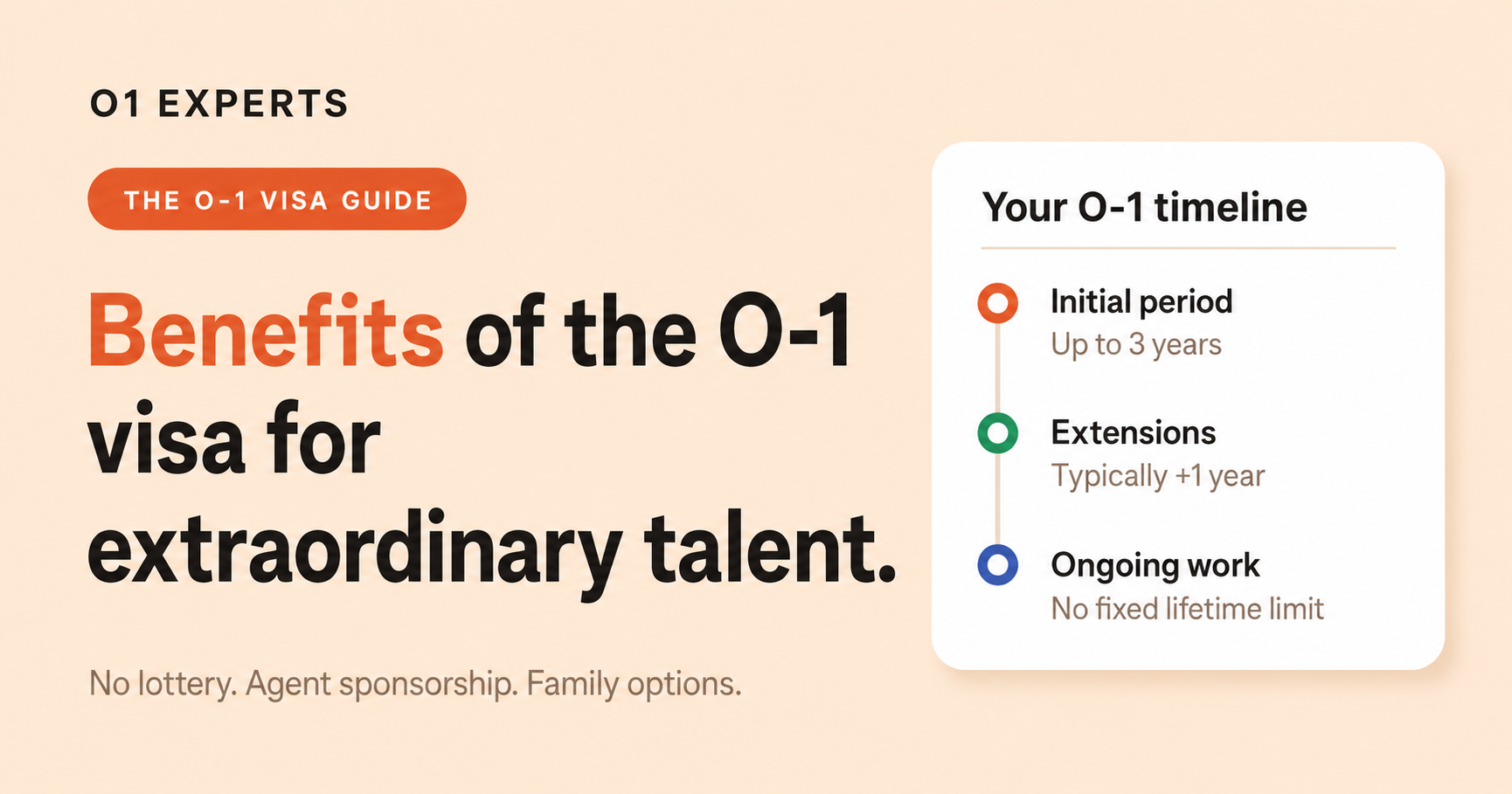
Explore the top O1 visa benefits, including no annual lottery, flexible agent sponsorship, family options, extensions, and future green card planning.
If your work has earned major recognition, the O-1 visa can open the door to professional opportunities in the United States without an annual lottery. It is designed for people who have built an extraordinary record in their field and want to continue that work in the U.S.
The main O1 visa benefits include flexible timing, up to three years initially, potential extensions, and agent sponsorship for qualifying multi-project careers. Your spouse and unmarried children under 21 may also accompany you in O-3 status.
At O1 Experts, we know an extraordinary career does not always fit a traditional employment model. Our services include acting as a U.S. petitioner and sponsor agent for qualified O-1A and O-1B candidates.
Here is what makes the O-1 valuable and what you need to understand before deciding whether it fits your goals.
What Is an O-1 Visa?
The O-1 is a temporary U.S. work visa for individuals with extraordinary ability or achievement. O-1A covers the sciences, education, business, and athletics. O-1B covers extraordinary ability in the arts and extraordinary achievement in motion pictures or television.
The visa is field-specific. You must show that you have reached a high level in your profession and that you are coming to the U.S. to continue work in your area of extraordinary ability. A U.S. employer or agent must file Form I-129 on your behalf; you cannot file the O-1 petition personally.
A qualified U.S. agent may petition in cases involving multiple engagements, end clients, or project-based work. The contracts, itinerary, and agent relationship must be documented correctly.
The Main O1 Visa Benefits
The O-1 combines a demanding standard with valuable work and planning advantages.
There Is No Annual Lottery or Numerical Cap
The O-1 is not subject to an annual numerical cap. You do not have to wait for a once-a-year registration window or hope your name is selected before a petition can be considered.
This gives qualified candidates more control over timing. USCIS recommends filing Form I-129 at least 45 days before employment begins, but generally will not accept it more than one year before the services are needed.
No cap means a qualified candidate can be judged on the petition's merits without first facing random selection. Approval is never automatic.
You Can Receive Up to Three Years Initially
USCIS may approve an initial O-1 stay for the time needed to complete the event or activity, up to three years. The requested period should be supported by contracts, deal memos, work dates, and a credible itinerary.
If your work continues, extensions may be available. USCIS commonly grants extensions in one-year increments when needed to continue or complete the same event or activity. There is no fixed lifetime number of O-1 extensions, but each request must remain eligible and be approved.
The O-1 does not create permanent status. You must maintain valid status and work within the approved petition.
An Agent Can Support Multiple Projects
Many exceptional professionals do not work for one company. Actors move between productions, musicians perform at different venues, and consultants serve multiple clients.
A properly structured U.S. agent petition can bring qualifying engagements together under one filing. This is one of the most practical O1 visa benefits for freelance and project-based careers.
The petition must explain the agent's role and include the required contracts or summaries, dates, locations, and itinerary. Without a qualifying agent petition, each employer may need to file separately. Material changes can require another filing.
The O-1 does not authorize unrestricted work in any industry. Your activities must remain within your field of extraordinary ability and within the approved petition.
There Is No Specific Degree Requirement
The O-1 focuses on achievement, not one required academic credential. Unlike visa categories built around a particular degree or specialty occupation, the O-1 allows a candidate to prove distinction through a broader professional record.
That can benefit professionals whose careers are better measured through impact and recognition than through a single diploma. The O-1 also does not require the H-1B labor condition application or its prevailing-wage framework, although genuine employment terms and other applicable rules still matter.
Your Family Can Accompany You
Your spouse and unmarried children under 21 may apply for O-3 classification. Their period of stay generally follows yours, allowing your immediate family to live with you while you complete your approved U.S. work.
O-1 visa holders may bring a spouse and unmarried children under 21 to the United States through O-3 status. A dependent who wants to work must qualify for separate work-authorized status.
O-3 classification is different from O-2. O-2 is for certain essential support personnel accompanying an O-1 artist or athlete and requires a separate petition.
The O-1 Can Fit Long-Term Green Card Planning
An O-1 visa does not guarantee a green card, but it can work well with a longer-term immigration plan. O-1 regulations do not require you to maintain a foreign residence that you have no intention of abandoning, and an approved permanent labor certification or immigrant petition is not, by itself, a reason to deny an O-1 petition.
The O-1 is therefore often described as "dual-intent-friendly," although it remains temporary. Some holders later pursue an EB-1A extraordinary ability green card, an EB-2 national interest waiver, or an employer-sponsored category. Evidence may overlap, but green card eligibility is a separate decision. Start planning early rather than treating O-1 approval as automatic EB-1A eligibility.
Premium Processing Is Available
When timing matters, a petitioner may request premium processing by filing Form I-907 and paying the additional fee. For qualifying O petitions, USCIS must take adjudicative action within 15 business days.
That action may be an approval, denial, Request for Evidence, notice of intent to deny, or investigation. Premium processing speeds up the USCIS response; it does not increase the legal strength of the petition or guarantee approval.
Premium processing can help with approaching professional deadlines, but it does not accelerate embassy appointments or additional consular processing.
Who Qualifies for the O-1 Visa?
The O-1 is sometimes called a celebrity visa, but it is not limited to household names. Founders, scientists, athletes, artists, business leaders, and other professionals may qualify.
For O-1A, a major internationally recognized award can establish the threshold on its own. Otherwise, a petitioner generally submits evidence meeting at least three of eight regulatory criteria. These include nationally or internationally recognized awards, selective memberships, published material about the candidate, judging the work of others, original contributions of major significance, scholarly authorship, a critical or essential capacity for distinguished organizations, and high remuneration.
O-1B uses standards tailored to the arts, motion pictures, and television, including evidence of leading roles, media coverage, commercial or critical success, expert recognition, and high remuneration.
Meeting the minimum number of criteria is not simply a box-checking exercise. USCIS considers the evidence as a whole. Your petition should show sustained national or international acclaim, or the applicable level of distinction or extraordinary achievement, and explain why your work stands out in your field.
Building Evidence That Shows Extraordinary Ability
Strong evidence is specific, objective, and easy to verify. Map every document to a criterion instead of expecting USCIS to make the connection.
Published material can be particularly useful when it focuses on you and your work. Include the full article, publication details, author, date, and evidence of the outlet's audience or professional importance. A brief name mention or a paid promotional item may not carry the same weight as an independent feature discussing your contributions.
Recommendation letters can add context when respected experts explain specific contributions and measurable impact. Generic praise does not replace independent documentation.
Other evidence may include:
- Awards and evidence of their prestige
- Contracts, deal memos, and itineraries
- Citations, patents, or adoption of original work
- Revenue, audience, or performance data
- Judging, speaking, or peer-review activity
- Salary comparisons
- A critical or essential capacity
Every piece should help answer the same question: why does this evidence show that you have achieved extraordinary standing in your field?
O-1 Visa Costs and Filing Logistics
The current Form I-129 fee for an O petition is generally $1,055, or $530 for a qualifying small employer or nonprofit, plus applicable additional fees. The Asylum Program Fee may also be $600, $300 for a qualifying small employer, or $0 for a nonprofit.
Premium processing costs $2,965 for eligible O petitions postmarked on or after March 1, 2026. Consular fees, advisory opinions, translations, document preparation, travel, and other third-party costs vary.
Attorney fees are separate and vary with complexity and scope. O1 Experts is not a law firm and does not provide legal advice or representation.
Government fees change. Confirm the total through the current USCIS Fee Schedule before filing rather than relying on an older article or checklist.
Travel, Status Changes, and Extensions
If you are outside the United States, an approved I-129 petition is generally followed by a visa application at a U.S. embassy or consulate. If you are already in valid U.S. status, the petitioner may request a change of status when appropriate. Approval inside the U.S. is not the same as a visa stamp for later travel, so plan travel carefully.
With a timely extension filed by the same employer, certain workers may continue for up to 240 days after the prior stay expires. Existing conditions still apply, and authorization ends if USCIS denies the petition. Do not assume this covers a new employer or materially different work.
Is the O-1 Better Than the H-1B?
It depends on your career and evidence. The O-1 has no annual cap, offers agent-petitioner options, and does not require a specific degree or labor condition application. The H-1B uses a different standard based on a specialty occupation and the worker's qualifications, and many private-sector cases face an annual cap-selection process.
The H-1B may be more realistic for someone who qualifies for a specialty occupation but has not built the record needed for O-1. Neither visa is universally better.
How O1 Experts Can Help
O1 Experts is a U.S. visa petitioner and sponsor agent for qualified O-1A and O-1B candidates. We begin by reviewing your background and identifying the evidence categories that best fit your achievements.
We help organize awards, press, publications, contracts, itineraries, citation records, and recommendation letters. When an agent structure is appropriate, we prepare the package and file Form I-129 as petitioner.
This can help qualified project-based professionals pursue U.S. opportunities without one traditional employer. We charge an upfront flat fee and take no percentage of future earnings.
We are not a law firm and cannot guarantee a government decision. What we can do is help you present your real achievements and planned work in a clear, organized petition.
Frequently Asked Questions
How Long Can I Stay in the U.S. With an O-1 Visa?
An initial petition may be approved for up to three years, depending on the time needed for the event or activity. Extensions are commonly available in one-year increments for the same activity, with no fixed numerical limit.
Can an O-1 Visa Lead to a Green Card?
It can be a stepping stone, but it does not convert automatically. Some holders later pursue EB-1A, EB-2 national interest waiver, or employer-sponsored permanent residence. Each requires a separate filing and independent eligibility.
Is an O-1 Visa Tough to Get?
Yes. The benefits are attractive because the standard is demanding. You need credible evidence showing extraordinary ability or achievement, a qualified petitioner, and documented U.S. work in your field.
Can I Work for More Than One Employer?
Yes, when the petitioning structure covers the work properly. Each employer may file a petition, or a qualifying U.S. agent may file for multiple engagements with the required contracts and itinerary. An O-1 approval is not unrestricted work authorization.
Put the O-1 Visa Benefits to Work for Your Career
The O-1 gives extraordinary professionals an uncapped, flexible route to U.S. work. Benefits include up to three years initially, extension potential, premium processing, multi-project options, O-3 family status, and compatibility with green card planning.
The key is showing that your achievements meet the standard and that your proposed work is real, documented, and connected to your field.
If you are ready to find out whether the O-1 fits your career, contact O1 Experts to schedule a free eligibility consultation.
Tags:
Ready To Get Started?
Fill out the form and our expert team will get back to you shortly.
Office Hours
Monday - Sunday: 8AM - 8PM PST
Our Address
609 Metairie Rd
#4013
Metairie, LA 70005