
US O Visa: Complete Guide for Extraordinary Professionals

The US O visa represents a unique opportunity for individuals with extraordinary abilities to work and contribute their talents in the United States. Designed specifically for those who have demonstrated exceptional achievement in their field, this nonimmigrant visa category allows professionals from around the world to pursue opportunities that match their expertise. Whether you're an acclaimed artist, a groundbreaking scientist, a successful entrepreneur, or a recognized athlete, understanding the nuances of the US O visa can open doors to career advancement and professional growth in one of the world's most dynamic markets.
Understanding the US O Visa Categories
The US O visa program divides applicants into distinct categories based on their field of expertise. This classification system ensures that each application is evaluated according to appropriate standards and criteria.
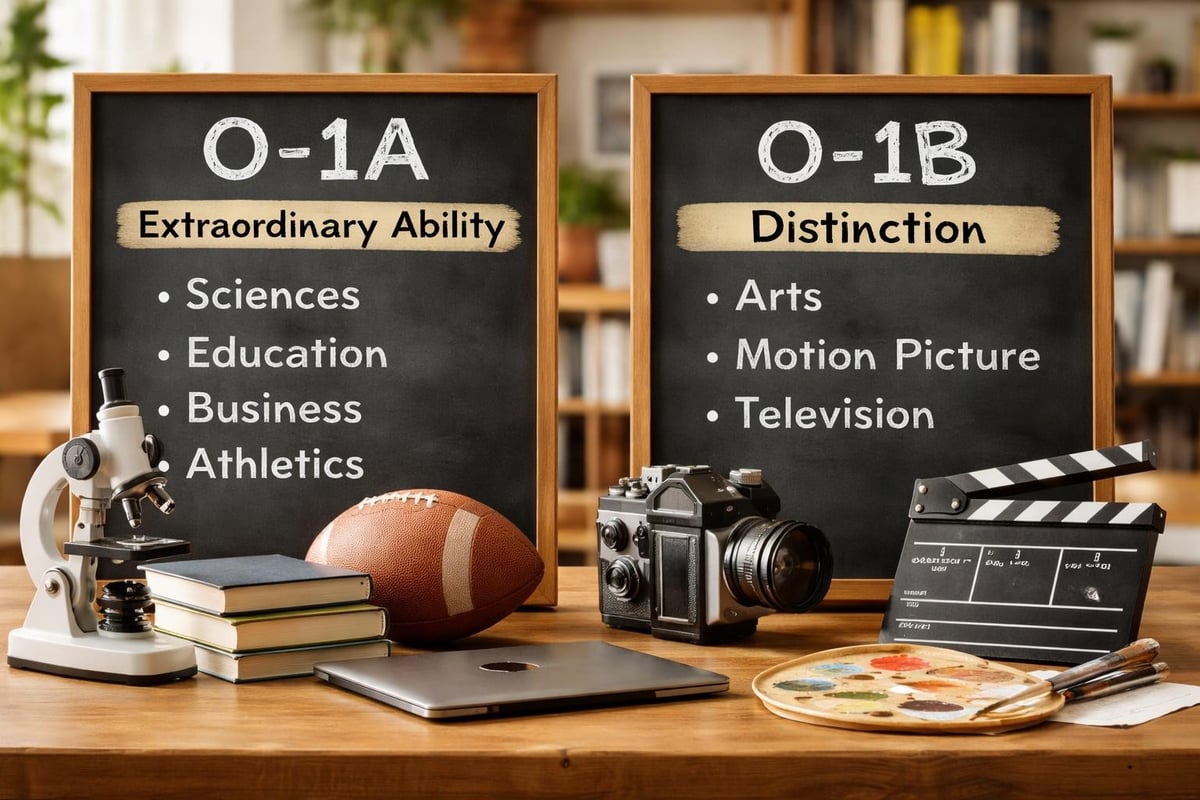
O-1A: Sciences, Education, Business, and Athletics
The O-1A category serves professionals who have demonstrated extraordinary ability in sciences, education, business, or athletics. This designation requires sustained national or international acclaim and recognition for achievements in your field. Extraordinary ability means you rank among the small percentage of individuals who have risen to the very top of your profession.
To qualify under O-1A standards, you must provide evidence of a major internationally recognized award, such as a Nobel Prize, or meet at least three of eight specific criteria. These criteria include:
- Receipt of nationally or internationally recognized prizes or awards for excellence
- Membership in associations requiring outstanding achievements
- Published material about you in professional or major trade publications
- Participation as a judge of the work of others in your field
- Original scientific, scholarly, or business-related contributions of major significance
- Authorship of scholarly articles in professional journals or major media
- Employment in a critical or essential capacity for distinguished organizations
- Command of a high salary or significantly high remuneration
O-1B: Arts, Motion Picture, and Television
The O-1B category addresses professionals in the arts, motion picture, or television industry. For most arts fields, you must demonstrate distinction, meaning a high level of achievement evidenced by a degree of skill and recognition substantially above that ordinarily encountered. However, those in motion picture and television must meet the higher standard of extraordinary achievement.
| Criterion Type | O-1A (Sciences/Business/Athletics) | O-1B (Arts) | O-1B (Film/TV) |
|---|---|---|---|
| Standard Required | Extraordinary Ability | Distinction | Extraordinary Achievement |
| Evidence Needed | 3 of 8 criteria or major award | 3 of 6 criteria | 3 of 6 criteria |
| Recognition Level | National/International | Professional | Industry-wide prominence |
Eligibility Requirements for the US O Visa
Meeting the basic qualifications represents just the starting point for a successful O-1 visa petition. The US O visa demands comprehensive documentation that proves your extraordinary status through objective evidence.
Building Your Evidence Portfolio
Your application strength depends on the quality and relevance of your supporting documentation. Each piece of evidence should clearly demonstrate your standing in your field. Advisory opinions from relevant peer groups, labor organizations, or management organizations form a critical component of your petition.
The evidence must show that you have sustained acclaim and that you are coming to the United States to continue work in your area of expertise. For those in the arts, your evidence might include:
- Leading or starring roles in productions with distinguished reputations
- Critical reviews or published material in major newspapers or trade journals
- Performances that have received significant recognition
- Commercial successes as measured by box office receipts or ratings
- Recognition from organizations, critics, or governmental agencies
- High salary compared to others in the field
Business professionals and scientists need to demonstrate contributions that have significantly impacted their field. This might involve patents that have been widely adopted, research that changed industry practices, or business innovations that created substantial market value.
The Role of Advisory Opinions
Every US O visa petition requires at least one advisory opinion from an appropriate peer group, labor organization, or management organization. Some cases may require multiple opinions, particularly if you work across different areas within your field. These opinions provide expert assessment of your qualifications and confirm that you meet the extraordinary ability standard.
The advisory opinion must describe your achievements and explain why you qualify for the US O visa. Organizations that issue these opinions evaluate your credentials against professional standards and provide their expert judgment regarding your status in the field.
Application Process and Timeline
Navigating the US O visa application involves multiple stages, each requiring careful attention to detail and precise documentation. Understanding this process helps you prepare adequately and avoid common pitfalls that can delay approval.
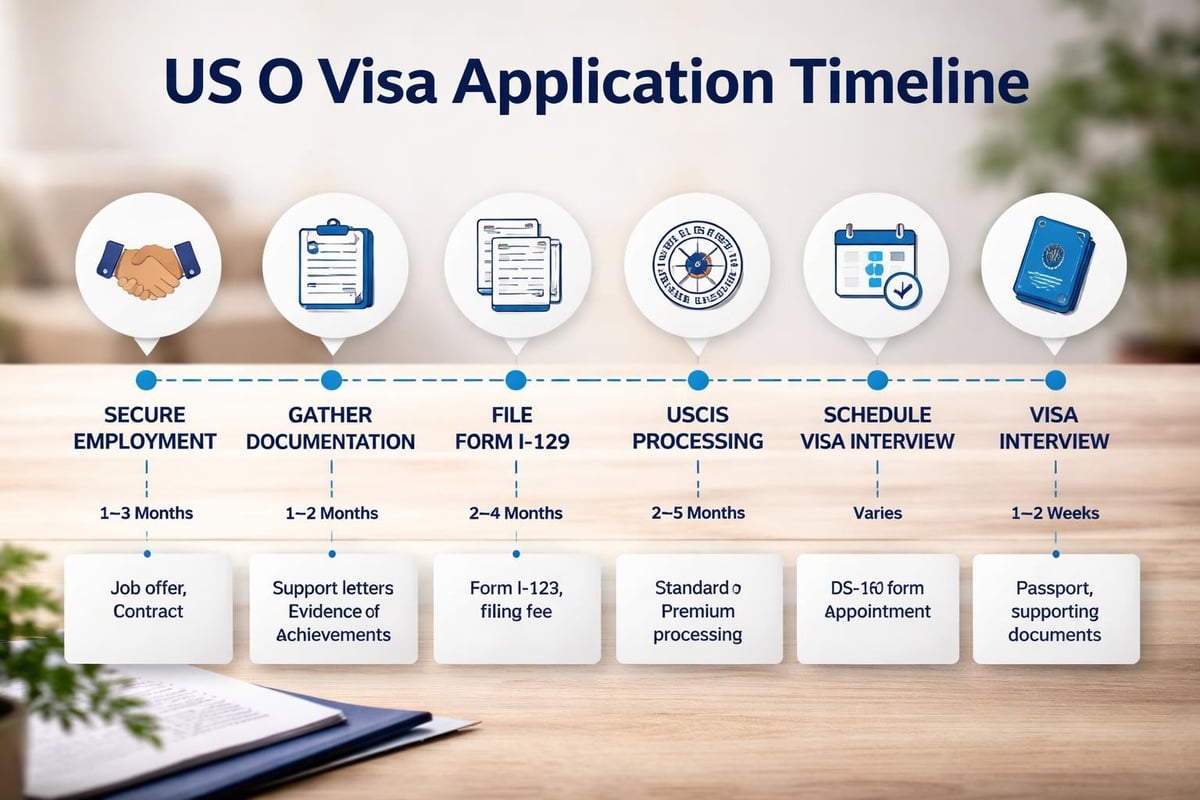
Step-by-Step Application Procedure
Step 1: Secure US Employment You must have a job offer or contract from a US employer or agent who will serve as your petitioner. The petitioner files Form I-129, Petition for a Nonimmigrant Worker, on your behalf. This relationship between petitioner and beneficiary forms the foundation of your application.
Step 2: Gather Documentation Collect all evidence supporting your extraordinary ability claim. This includes awards, publications, media coverage, letters from experts in your field, and any other materials demonstrating your achievements. Professional guidance on documentation requirements can prove invaluable during this stage.
Step 3: Obtain Advisory Opinions Request advisory opinions from appropriate peer groups or organizations. Allow sufficient time for these organizations to review your credentials and issue their opinions, as this process can take several weeks.
Step 4: File the Petition Your petitioner submits Form I-129 with all supporting documentation and advisory opinions to USCIS. Premium processing is available for an additional fee, reducing processing time to 15 calendar days.
Step 5: Await USCIS Decision USCIS reviews your petition and either approves it, requests additional evidence, or denies it. If approved, you receive a Notice of Action (Form I-797) that allows you to proceed with visa stamping if you're outside the United States.
Step 6: Visa Interview (if applicable) If you're outside the United States, schedule an interview at a US embassy or consulate. Bring your approval notice, passport, and supporting documents to the interview.
Processing Times and Expedited Options
Standard processing for the US O visa typically ranges from two to three months, though times vary by service center and current USCIS workload. Premium processing offers a faster alternative, guaranteeing a response within 15 calendar days for an additional fee of $2,500 as of 2026.
Planning ahead is essential. Start your application process at least three to four months before your intended start date to account for potential delays or requests for additional evidence. The petition can be filed up to one year before the employment start date but no later than 45 days before.
Common Challenges and Solutions
Even well-qualified candidates encounter obstacles during the US O visa application process. Understanding these challenges helps you prepare more effectively and increases your chances of approval.
Demonstrating Sustained Acclaim
One frequent challenge involves proving that your achievements represent sustained acclaim rather than isolated successes. USCIS looks for patterns of recognition over time, not just a single award or achievement. Build your case by showing consistent recognition through multiple forms of evidence spanning several years.
For instance, combining membership in professional associations with published articles about your work, plus evidence of judging others' work, creates a stronger narrative than relying solely on one criterion.
Field-Specific Documentation
Different fields require different types of evidence, and what works for a scientist may not apply to an entrepreneur. Business professionals sometimes struggle because their achievements don't fit traditional academic or artistic benchmarks. In these cases, focus on:
- Revenue growth or market impact you've generated
- Industry awards and recognition from business organizations
- Media coverage in business publications
- Speaking engagements at major conferences
- Board positions or advisory roles with prominent companies
Athletes face unique challenges in documenting achievements, especially in sports not widely followed in the United States. Emphasize international competitions, national rankings, and recognition from sports governing bodies.
Addressing Requests for Evidence
USCIS may issue a Request for Evidence (RFE) if they need additional information to make a decision. Understanding how to respond to an RFE effectively is crucial. Read the request carefully, address each point specifically, and provide exactly what USCIS asks for without overwhelming them with irrelevant material.
Common RFE topics include:
- Clarification of the petitioner-beneficiary relationship
- Additional evidence of extraordinary ability
- More detailed explanation of the proposed work in the United States
- Updated or additional advisory opinions
Duration, Extensions, and Family Considerations
The US O visa provides flexibility in terms of initial duration and the ability to extend your stay as your work in the United States continues.
Initial Period and Extensions
Your US O visa is initially granted for up to three years, based on the time needed to accomplish the event or activity for which you're coming to the United States. This might be a specific project, a series of performances, or ongoing work with an employer.
Extensions are available in one-year increments with no maximum limit, provided you continue to work in your area of extraordinary ability. To extend, your petitioner files a new Form I-129 before your current status expires, demonstrating that you're still engaged in work requiring your extraordinary abilities.
| Visa Aspect | Initial Grant | Extensions | Requirements |
|---|---|---|---|
| Duration | Up to 3 years | 1 year increments | Continued work in field |
| Application Timing | Up to 1 year before start | Before current status expires | Form I-129 required |
| Maximum Stay | No limit | Unlimited extensions possible | Must maintain extraordinary ability |
O-3 Dependent Visas
Your spouse and unmarried children under 21 can accompany you to the United States on O-3 dependent visas. O-3 visa holders can attend school but cannot work in the United States. They may remain in the country for the same duration as your O-1 status, including extensions.
To obtain O-3 visas, dependents must prove their relationship to you through marriage certificates or birth certificates. They can apply either concurrently with your initial petition or separately after you receive approval.

Comparing the US O Visa to Other Options
Understanding how the US O visa compares to alternative visa categories helps you choose the best path for your situation. Each visa type serves different needs and has distinct advantages.
O-1 Versus H-1B
The H-1B visa serves specialty occupation workers but comes with significant limitations. Annual caps restrict H-1B availability, with only 65,000 regular visas and 20,000 advanced degree visas available each year. The US O visa has no annual cap, making it accessible year-round without lottery concerns.
The H-1B alternative also requires a specific employer-employee relationship and limits you to working only for your sponsoring employer. The US O visa offers more flexibility, allowing you to work with an agent who represents you across multiple engagements.
O-1 Versus EB-1A Green Card
The EB-1A green card provides permanent residence for individuals with extraordinary ability, similar to the O-1 standard. While the criteria overlap significantly, the EB-1A leads to permanent residence rather than temporary status. Many professionals use the US O visa as a stepping stone toward an EB-1A green card, building their evidence portfolio while working in the United States.
The EB-1A doesn't require a job offer, allowing self-petition, but it demands stronger evidence of extraordinary ability. If you qualify for an O-1 visa, you may be close to EB-1A eligibility and should consider pursuing permanent residence.
Industry-Specific Considerations
Certain industries have developed specific pathways and expectations for the US O visa. Artists and entertainment professionals often use this visa category, with well-established precedents for what constitutes extraordinary ability in these fields.
Tech entrepreneurs and startup founders increasingly leverage the US O visa, particularly when H-1B limitations prevent their employment. The visa accommodates various work arrangements, from traditional employment to consulting engagements through an agent.
Maintaining Status and Future Pathways
Once you receive your US O visa, maintaining your status and understanding your long-term options becomes essential for continued success in the United States.
Status Maintenance Requirements
Maintaining your O-1 status requires continuing to work in your area of extraordinary ability. You cannot engage in unauthorized employment or work for employers other than those listed in your petition. If you want to change employers or add additional employers, your new petitioner must file an amended petition.
Travel considerations also affect your status. You can travel internationally while holding O-1 status, but you must maintain a valid visa stamp for reentry. If your visa stamp expires while you're in the United States, you'll need to apply for a new stamp at a US embassy or consulate abroad before returning from international travel.
Keep detailed records of your continued achievements and recognition. This documentation becomes valuable when filing for extensions or transitioning to permanent residence.
Transition to Permanent Residence
Many O-1 visa holders eventually pursue green cards through the EB-1A or EB-2 NIW (National Interest Waiver) categories. The evidence you've compiled for your US O visa applications provides a foundation for these permanent residence petitions.
Working with experienced professionals who understand both temporary and permanent visa strategies can help you plan your immigration pathway efficiently. Comprehensive visa assistance ensures your O-1 status supports your long-term goals.
Working with Petitioners and Agents
The relationship between you and your petitioner significantly impacts your US O visa experience. Understanding your options for petitioners helps you structure your work arrangements effectively.
Employer Petitioners
A US employer can petition for your US O visa if you'll work directly for them. This straightforward arrangement works well for traditional employment relationships where you'll have a single primary employer. The employer must demonstrate that they need your services and that you'll engage in work requiring extraordinary ability.
Agent Petitioners
Agents can petition on behalf of beneficiaries who work with multiple clients or employers. This arrangement particularly benefits professionals in entertainment, consulting, or fields where project-based work is common. The agent acts as your representative, allowing you to work for various organizations without requiring separate petitions from each one.
When using an agent, your petition must include:
- Contracts between you and the agent
- Explanation of the agent's role
- Itinerary or summary of the events or activities you'll perform
- Contracts between the agent and end-clients (if available)
Understanding how to work effectively with an O-1 visa agent ensures compliance while maximizing your professional flexibility.
Financial and Logistical Considerations
Planning for the financial and practical aspects of your US O visa application helps you budget appropriately and avoid surprises.
Application Costs
The US O visa involves several fees that petitioners and beneficiaries should anticipate. As of 2026, the basic filing fee for Form I-129 is $1,055. Premium processing adds $2,500 if you need expedited adjudication. Additional costs include:
- Visa application fee (DS-160): $205 per person
- Advisory opinion fees: Varies by organization, typically $0 to $500
- Translation and document preparation: $500 to $2,000
- Legal or professional assistance: Varies widely based on complexity
Budget between $3,000 and $10,000 total for a complete US O visa application, depending on whether you use professional assistance and how much documentation preparation your case requires.
Practical Timeline Planning
Create a realistic timeline that accounts for all application stages. Factor in time for:
- Gathering documentation: 2-4 weeks
- Obtaining advisory opinions: 3-6 weeks
- USCIS processing: 2-3 months (standard) or 15 days (premium)
- Visa interview scheduling and processing: 2-4 weeks
Starting your preparation at least five months before your intended start date provides a comfortable buffer for unexpected delays or requests for additional evidence.
The US O visa offers extraordinary professionals a flexible, powerful pathway to work in the United States across virtually any field. By understanding the eligibility criteria, preparing comprehensive documentation, and navigating the application process strategically, you can successfully leverage this visa category to advance your career. Whether you're seeking expert guidance on O-1 visa sponsorship or need comprehensive support throughout your application, O1 Experts provides specialized assistance tailored to your unique situation, ensuring your petition showcases your extraordinary abilities effectively and meets all USCIS requirements.
Ready To Get Started?
Fill out the form and our expert team will get back to you shortly.
Office Hours
Monday - Sunday: 8AM - 8PM PST
Our Address
609 Metairie Rd
#4013
Metairie, LA 70005